Monday, 7 February 2022

We Analyzed 50,000 Social Media Posts From the Last 12 Months to Learn How to Get More Organic Traffic. Here’s What We Found.

We Analyzed 50,000 Social Media Posts From the Last 12 Months to Learn How to Get More Organic Traffic. Here’s What We Learned.

Facebook, Instagram, LinkedIn, Pinterest and every other social network you can think of eventually does the same thing.

Can you guess what it is?

They adjust their algorithms to cram down reach and sharing. That means you won’t get as much traffic from them unless you start advertising.

But even with their algorithm changes, there must be a way to maximize the traffic you can get from each social network, right?

In order to find out, we analyzed over 50,000 social media posts sharing content in 10 different industries.

The posts analyzed were some of the most shared on Facebook, Twitter, and Pinterest from the last 12 months and contained a link to industry-related content. We couldn’t get access to enough data from other social media channels.

What Industries Did We Look At?

Although there are tons of different industries out there, we focused on the following 10 that contained the majority of posts and social media engagement. This allowed us to share better insights on what can be done to get more organic social traffic.

Here are the 10 industries we looked at:

  • Business
  • E-commerce
  • Fashion
  • Food
  • Health
  • News
  • Politics
  • Sports
  • Technology
  • Travel

Analysis #1: Social Media Engagement For Each Industry Over the Last 12 Months

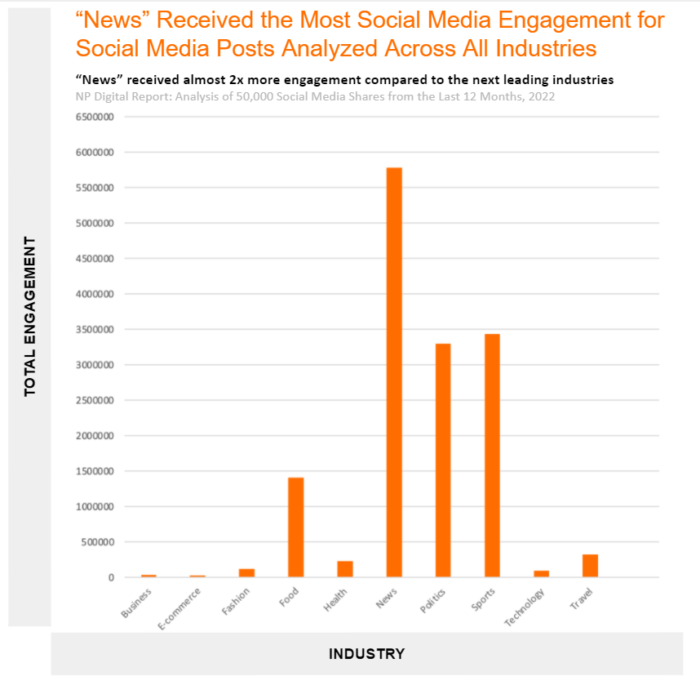
The first graph below shows the total social media engagement for content related to each industry over the last 12 months. This is the grand total and not a monthly average.
Analysis-1-Total-Social-Media-Engagement-for-Content-Related-to-Each-Industry

The key highlight is that News-related posts had the most engagement followed by Sports and then Politics.

It’s worth noting that social media posts related to Business and E-commerce received virtually no engagement which might highlight some trends for both industries.

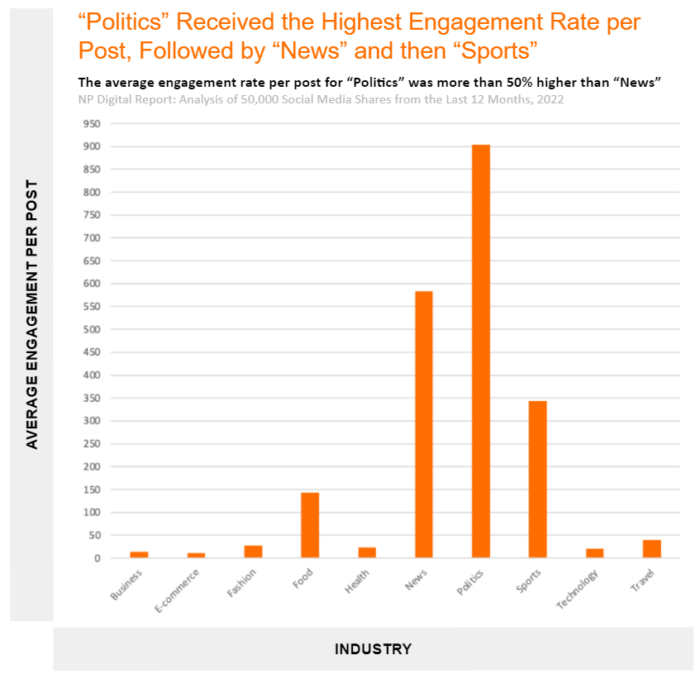
To make sure the data wasn’t biased or skewed, we also looked at the average engagement data for each post versus just the total.
Analysis-1-Average-Monthly-Social-Media-Engagement-for-Each-Industry

The results were similar for the majority of industries, but with one key difference. Even though News received the most total social media engagement, it was behind Politics when looking at the average engagement per post. 

But as everyone knows, don’t talk about politics at the dinner table. In other words, you don’t want to polarize your audience.

Regardless of which industry you belong to, incorporating news-related subjects in your content could be a great way to get more engagement and traffic.

For example, if you own a music-related website, you may try to break news or write about it on your blog such as when Apple bought a company called Beats by Dre years ago. If the acquisition took place today, Apple would want to make sure their blog covered the move and then share it across their social media channels for added engagement.

Alternatively, if you were a business-related website, you could discuss the Beats by Dre acquisition from your perspective. Even if you aren’t the first company talking about it, you can discuss why they made the move and share your top 5 predictions for what will happen over the next 5 years.

On another note, let’s say you own a travel-related website. You could talk about restrictions each country has with quarantining and how it gets adjusted on a monthly or even weekly basis.

Regardless of what industry you are in, there are always opportunities to tie in the news which can lead to more social engagement, resulting in more organic traffic to your website.

Analysis #2: What Type of Content Works Best on Social Media Networks?

For fun, we also looked at which industries performed the best on each social network in terms of shares.

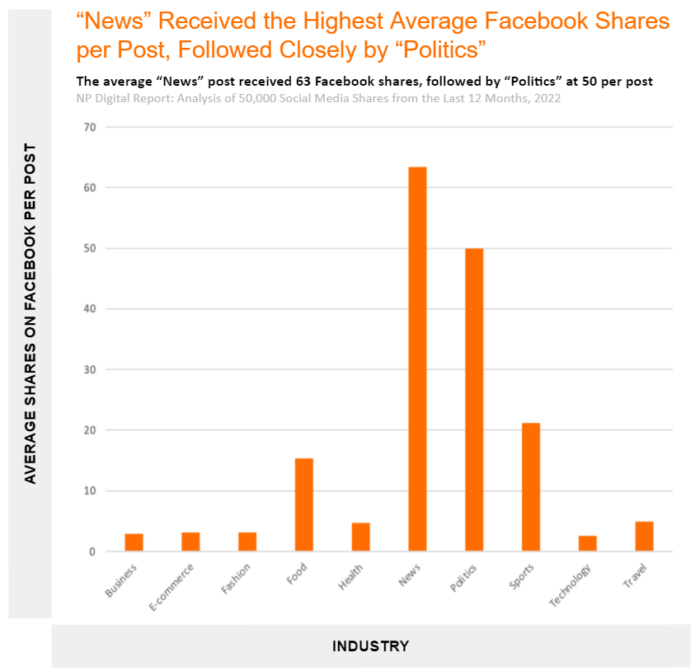
Here are the average Facebook shares for content related to each industry:
Analysis-2-FACEBOOK-Average-Shares-for-Content-Related-to-Each-Industry

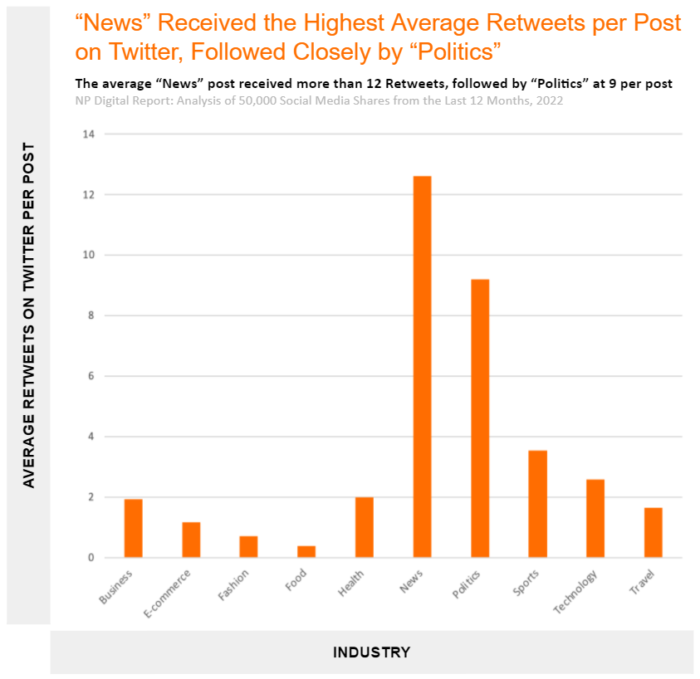
And here is what the data looks like for Twitter.
Analysis-2-TWITTER-Average-Shares-for-Content-Related-to-Each-Industry

And Pinterest…

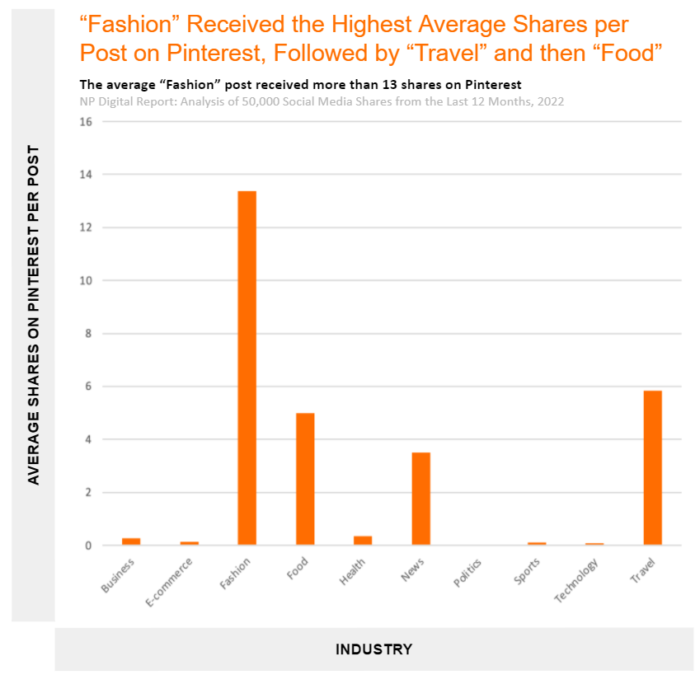
Analysis-2-PINTEREST-Average-Shares-for-Content-Related-to-Each-Industry

No shocker, but Facebook and Twitter prefer News-related content. Pinterest, on the other hand, prefers content that is more visual so industries such as Fashion, Travel, and even Food performed better.

As I mentioned before, if you want to get more traffic from Facebook and Twitter, find ways to tie in News-related topics or events to your content. Even if you aren’t a part of the industry it can help you get traction.

But if you want more traffic from Pinterest, focus on anything that is visual.

Now, none of that is really eye-opening. So we decided to dig a bit deeper to see the types of content that were most popular on these platforms.

I would assume infographics would perform best as they are easily shareable and are easy to generate links to.
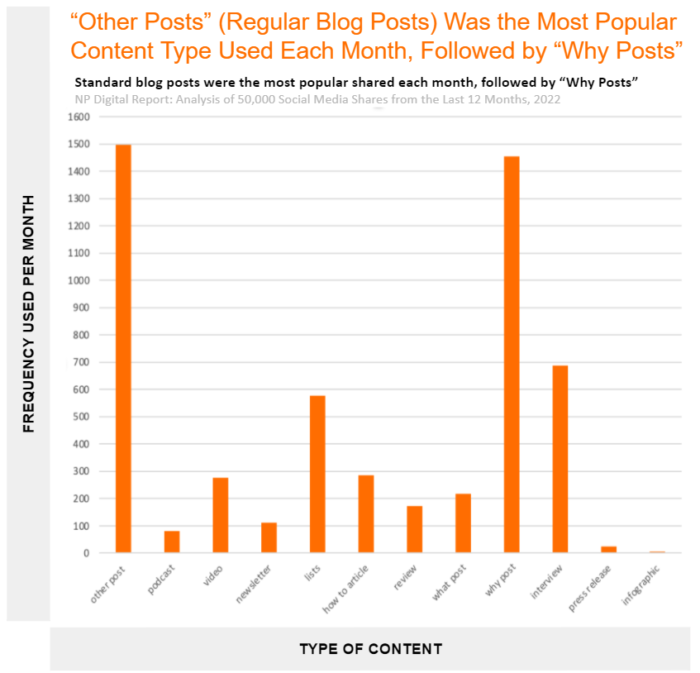
Analysis-2-Average-Type-of-Content-for-Each-Social-Media-Posts-Per-Month

Funnily enough, infographics had the worst performance from a social standpoint.

On the flip side, I would never have guessed that “why” posts and “interview” based posts would do so well.

List-based content is pretty much a given as everyone loves lists such as “The 7 benefits of green tea”.

As for the appeal of why-based posts, think of topics like “why isn’t there an eclipse every month” or “why don’t people wear white after labor day”.

For interviews, people want to hear from people who intrigue them. For example, if you were to be able to get an interview with business leaders like Elon Musk or Jeff Bezos, athletes like Lebron James or Cristiano Ronaldo, or even political figures who are trending at the time, you can bet it will get a lot of social shares.
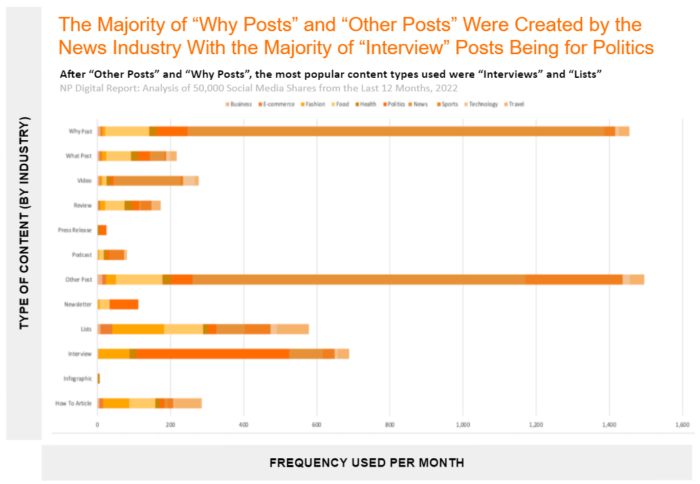
Analysis-2-Average-Type-of-Content-Per-Post-For-Each-Industry-Per-Month

In case you were curious about which content type was leveraged most by each industry, the graph above shows that. You can see how the News industry releases a lot of why-related content but industries like Business or E-commerce don’t leverage them as much.

You can use this data to find gaps and leverage the content type that has the highest likelihood of generating traffic for your industry.

Analysis #3: The Relationship Between Total Engagement and Total Shares of Each Industry

Some content gets shared a lot while others get a ton of engagement such as comments and likes. However, just because a piece of content gets a lot of comments, it doesn’t necessarily mean people like it and want to promote it to their network.

The more shares a piece of content has, the higher the chances are of you getting more traffic.
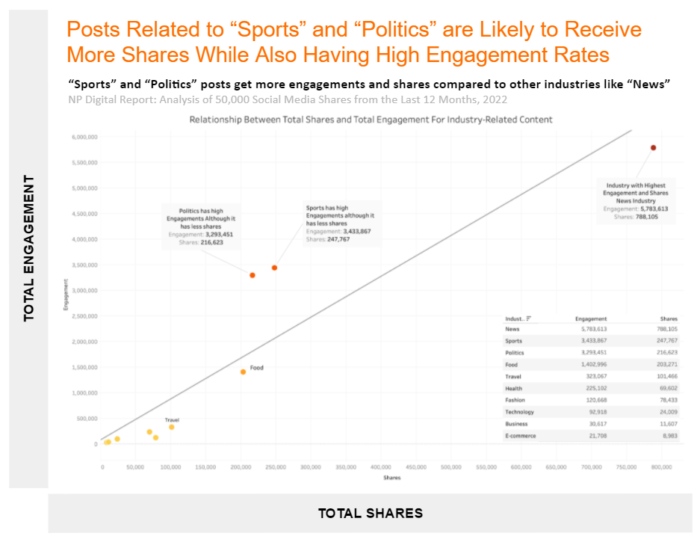
Analysis-3-Relationship-Between-Total-Engagements-Total-Shares-Per-Industry

The graph above clearly shows this for each industry. If you create polarizing content, such as political content or sports-related content with a lot of diehard fans and haters, it doesn’t mean engagement alone will result in more traffic (it can but not always).

A great example of this is if I posted a piece of content on “Why the Los Angeles Lakers will win the NBA championship”. I will get tons of comments from people who support any one of the other 29 NBA teams on why I’m wrong and how their team has a better chance of winning.

Engagement on social media is great, but it can only take you so far. That is why the goal of this study is to figure out how to use social media sites to generate more organic traffic for your website and not just get “engagement”.

News clearly is the winner on both fronts if you look at the chart above. So, again, try to tie it into your content wherever possible.

Analysis #4: How Long Should Your Content Be And When Should You Share It?

For the next analysis, we thought it would be fun to look at how long your articles should be and when you should share them to get the most social traffic.

Did you know that the average article that ranks on page 1 of Google contains 1,447 words?

It used to be around 3,000 words, then in the low 2,000s and now 1,447.

With social media, we wanted to see how long content should be to generate the most shares.

Let’s first look at the average word count per industry for the 50,000 most popular articles shared.
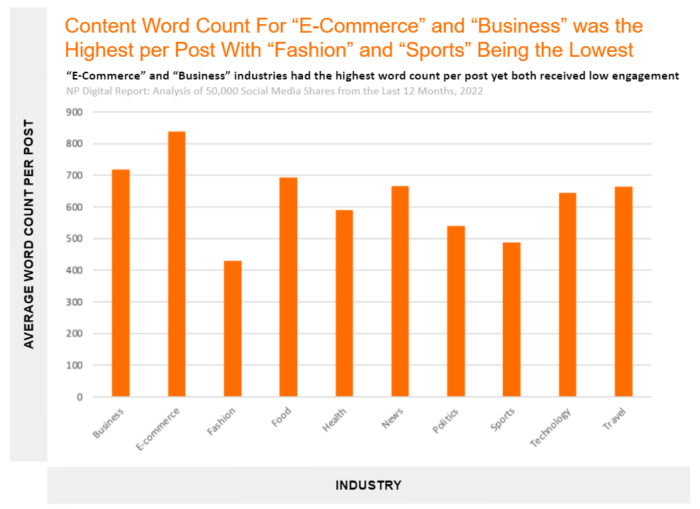
Analysis-4-Average-Word-Count-for-Content-Related-to-Each-Industry

As you can see, they are short. Really short (700 words or less for most industries).

E-commerce had the highest word count, followed closely by Business. However, both of these industries had the lowest number of total engagements and total shares based on the previous charts I shared above.

Although Google may prefer long-form articles, people on social media prefer short articles over longer ones.

When you look at the articles people prefer sharing (not liking, but sharing), it is also clear that people prefer sharing shorter articles.
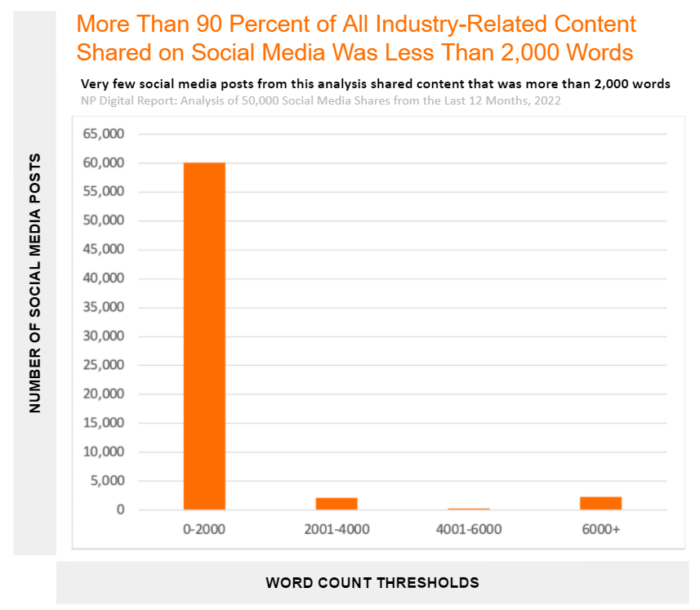
More than 90 percent of all content pieces shared on social media from this analysis were less than 2,000 words in length.

Getting someone to actively share an article is a lot rarer than simply clicking the “like” button. Keep in mind that people can share the same article over and over again.

As for when to release and promote your content, not all days are equal. It also varies per industry as well.
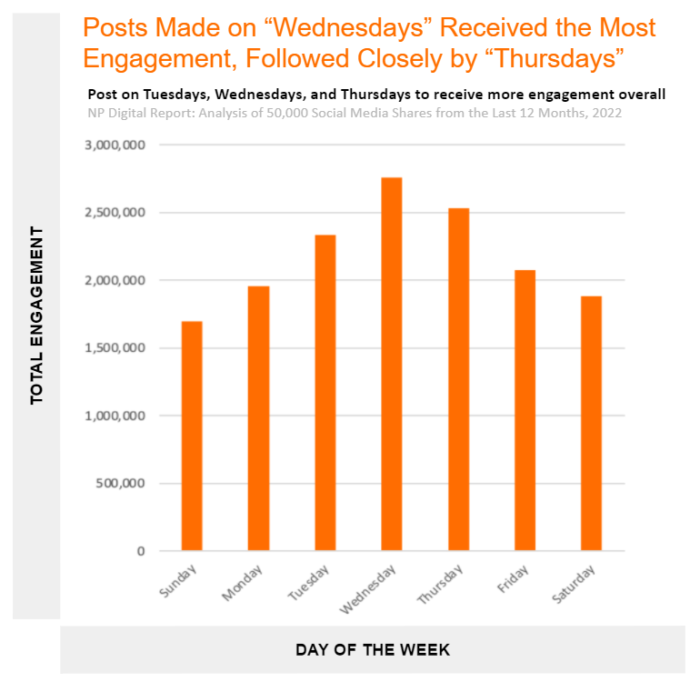
Analysis-4-Total-Social-Media-Engagements-For-Each-Day-of-the-Week

In general, people enjoy engaging with content most on Wednesdays followed by Thursdays and Tuesdays.

However, it isn’t that simple. Releasing content on Wednesday won’t guarantee success as it is different for each industry.
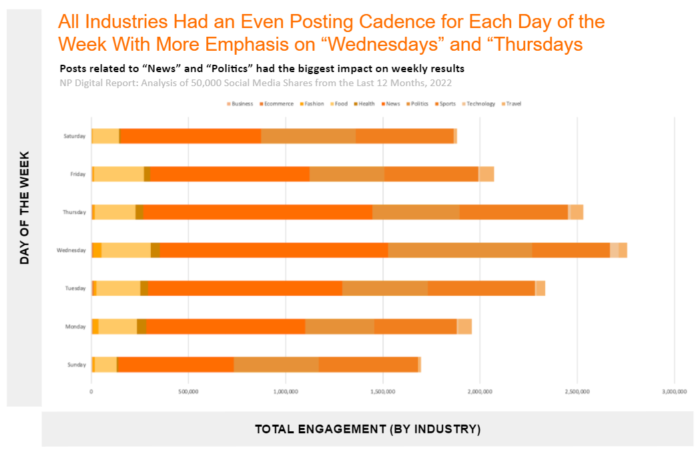
Analysis-4-Total-Engagement-For-Each-Day-of-the-Week-by-Industry

I know the graph above is hard to see as News dominates the results. So here is a version that doesn’t include News.
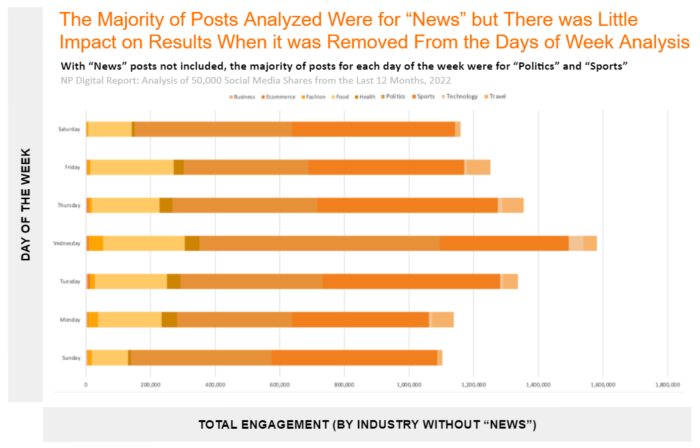
Analysis-4-Total-Engagement-For-Each-Day-of-the-Week-by-Industry-NO-News

If you are in the “Food” industry you can promote your content on Wednesday but you will also do really well on Friday even though that day doesn’t work as well for other industries.

Analysis #5: Most Common Type of Facebook Reaction for Each Industry

This one was fun because we were able to pull the most popular reactions people give to posts on Facebook.
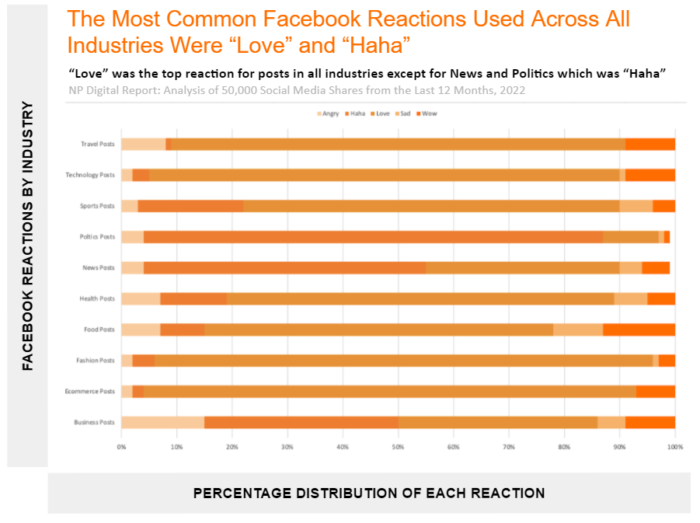
Analysis-5-Types-of-Facebook-Reactions-for-Posts-Related-to-Each-Industry

This graph shows the type of Facebook reaction (Angry, Haha, Love, Sad, Wow) that users had for posts related to each industry. Facebook reactions are the next generation of “likes” for the platform.

The key finding is that the two most popular types of reaction for all industries were either “Haha” or “Love”.

Outside of News and Politics, where the top reaction was “Haha”, “Love” was the most popular reaction for all industries.

If you want your content to do well, create content that conveys the feeling of “love” or makes people laugh. Those are the two types of reactions that people want to give the most.

Conclusion

There were a lot of interesting findings from the charts above.

The big takeaway for me was to create why-based content and write short articles if you want to do well on social media.

In general, you’ll want to:

  • tie content to relevant news
  • create why-based content or interview well known figures
  • write shorter posts of 700 words or less to share on social media instead of 2,000+ word articles
  • promote your content on Wednesday (for most industries) to get the most engagement
  • create content that leverages the feeling of love or makes people laugh

Did you learn anything new from the above charts and data?


from Blog – Neil Patel https://ift.tt/E6ngzK8
via IFTTT

How to conduct a LinkedIn audit that brings your brand to life

While your 2022 New Year’s resolution probably wasn’t “do a LinkedIn audit,” now is a great time to say “new year, new me” with your company profile.

It may be the world’s largest professional network, but LinkedIn is much more than a place to post jobs. With 810 million members and LinkedIn sessions growing 30% at the end of 2020, it’s an increasingly important hub for employee advocacy, brand awareness, lead generation and more.

LinkedIn is keeping up with the times—follow these tips to conduct a Linkedin audit that helps you get the most out of this ever-evolving platform:

1. Polish your profile
2. Get to know your audience
3. Clean up your content
4. Evaluate your paid campaigns
5. Analyze competitor performance

Polish your profile

Completing your company Page is more than making it look nice. According to LinkedIn, complete profiles see a 30% increase in weekly pageviews.

Your profile is a key place to communicate your brand identity and make a good first impression with new followers, job seekers, investors, customers and more. Here are the top items to complete, improve or add to your Page:

Step 1: Complete your profile

If you haven’t completed your company profile, you probably recognize this handy Page completion meter.

LinkedIn profile completion meter showing incomplete profile tasks

Kicking off your LinkedIn profile audit here is a no-brainer. And if you have completed these items, ensure they’re all up to date.

These are the basic details needed for a profile to be considered complete:

  • Industry
  • Company size
  • Website URL
  • Description
  • Logo
  • Street address
  • Custom button
  • Your first post
  • Hashtags

Pro tip: Don’t forget about your call-to-action button and your tagline. While this 120-character line isn’t required, it’s a great place to feature your slogan, info about your company and to show that you’ve put in extra effort.

Step 2: Is your page SEO-friendly?

Your Page’s “About” section is the best place for you to describe your company’s story and mission.

And at 2,000 characters or less, it’s also a great place to boost your Page’s SEO—both for searches in LinkedIn and in search engines, which will preview the first 156 characters of this section.

A screenshot of sprout's linkedin preview appearing in a Google searchGrammarly puts the focus on their product and the human element behind it.

A screenshot of Grammarly's LinkedIn page's About section description

Allbirds highlights their commitment to sustainability.

A screenshot of Allbirds LinkedIn About section

Lead with relevant, varied keywords to help searchers and search engines understand what you’re all about. Then, get creative—LinkedIn recommends including your vision, mission, values, positioning, tagline and products/services.

Step 3: Highlight your remote work and vaccination policy

Knowing whether a company offers remote or hybrid work has become an important part of the job search. Recent data shows employees want more flexibility, with 52% preferring a flexible work model post-pandemic vs. just 30% pre-pandemic.

A screenshot of Nike's LinkedIn page where you can see their hybrid workplace policy

Use the new Workplace module to be upfront with job seekers about your remote work and vaccine policies right away.

A screenshot of LinkedIn's new workplace module

Step 4: Audit your images

Looks can be deceiving—you could have the best company in the world, but a fuzzy logo and missing cover image don’t project that quality to the world.

A logo and cover image consistent with the branding of your website and other social platforms make you instantly recognizable to those looking for you on LinkedIn.

Logo

Does your logo reflect your current branding? Is it appropriately sized? Does it appear crisp and legible?

Make sure your logo is within the recommended size of 300 x 300 pixels and in JPG, PNG or GIF format.

Cover image

At a recommended size of 1128 x 191, your cover image is additional real estate where you can bring your brand to life by:

  • Emphasizing branding
  • Showing off your products
  • Highlighting what your company does
  • Visualizing company culture
  • Promoting upcoming events
  • Supporting causes and communicating your values

For B2C companies like Adidas, it’s a great place to highlight your breadth of product offerings.

Screenshot of Adidas' cover image on LinkedIn, showcasing different branded products.

Microsoft uses their cover image to inject their brand colors, logo and stunning imagery.

Screenshot of Microsoft's LinkedIn cover image, showing different flowers organized as the brand's logo.

Duolingo’s TikTok-famous owl mascot dances across their cover image and extends their brand color beyond their logo.

Screenshot of Duolingo's LinkedIn cover image, featuring their mascot Duo the owl.

Adjusting your images is easy, too. Use free photo editing apps like Canva and Sprout Social’s image resizing tool.

Step 5: Are you limiting the power of your profile?

From nurturing employee advocacy to generating qualified leads, using different kinds of Pages within your profile can support your business beyond marketing.

Here are a few to consider:

  • My Company Page—Celebrate employee wins and find trending employee content
  • Product Pages—Feature up to 10 different products and generate leads with call-to-action buttons
  • Showcase Pages—Valuable if you have multiple brands in your organization, separate business units or initiatives focused on distinct target audiences
  • Events—Share in-person or external events, or apply to use LinkedIn Live.
  • Career Pages—The Life, What We Do and Jobs tabs can help you build community, connect you with top candidates faster and build an even sleeker profile

Get to know your LinkedIn audience

Knowing who follows you can help you reach your target audience and guide Page edits, content creation and paid campaigns. An audience of high-level executives, for example, will have different needs than a beginner-level crowd.

So how do you get to know your audience? One way is by using LinkedIn’s analytics to see who is engaging with your ads and visiting your website.

The other is by using Sprout Social’s LinkedIn Pages Report to get an in-depth look at your followers.

Screenshot of Sprout Social's LinkedIn Pages report.

This report can help paint a picture of your followers by looking at what job functions your audience has and where they are in their career.

Clean up your content

While other social channels are about memes and trending dances, LinkedIn is more buttoned up…perhaps with the exception of “Broetry.”

With six out of 10 users actively looking for industry insights on LinkedIn, refining your content strategy is an important part of building trust and your reputation as a thought leader.

And considering employees are 14x more likely to share from their company’s page vs other brands, you have a share-ready audience waiting for you.

Here are some tips on conducting your content audit:

Step 1: Gather your post data

If the thought of scrolling through all of your posts to tally engagement gives you nightmares, don’t worry—there are plenty of ways to gather data quickly.

Screenshot of Sprout Social's post performance report

Using Sprout Social’s Post Performance Report empowers you to look at your highest and lowest performing posts in one place. Here’s how:

  1. From your Dashboard, navigate to Reports
  2. Under Cross-Network Reports, select Post Performance
  3. In the “Sources” section, select your LinkedIn Page(s)
  4. Set the time frame you want to analyze posts from
  5. Download the data as a PDF or CSV

Downloading your data as a CSV makes it easier for you to analyze.

Step 2. Look at what’s working, and what isn’t

With the most recent LinkedIn algorithm prioritizing relevant content in the newsfeed, it’s important to know what resonates with your audience.

Screenshot of a post that Slack published on their LinkedIn

In the Sprout CSV you pulled, you can look at key performance indicators (KPIs) to determine what pieces of content did well for you, and what didn’t. Here are some top KPIs to track:

  • Engagement rate
  • Impressions
  • Engagements
  • Total reactions
  • Types of reactions (Likes, Love, etc.)
  • Comments

There are many different content types you can publish on LinkedIn—articles, text posts, PDFs and slides, photos, polls and live videos. Knowing which of these posts perform the best can help guide every part of your content strategy.

A Starbucks post on LinkedIn

Step 3. Audit content quality

What content underperformed, and what affected its quality? How were the visuals? Did it come off as spammy?

There are a number of factors that can get your post flagged as spam to the LinkedIn algorithm. Here are a few do’s and don’ts to avoid this:

Step 4. Analyze your posting times

Timing is everything—make sure you’re identifying the best times to post on social media to reach your audience. Look at your most successful posts to see if there is a pattern when it comes to when you published them.

Sprout’s patented Optimal Send Times technology can also identify peak posting times as you publish.

Screenshot of Sprout's optimal send times tool

Similarly, take a look at how much you’re posting. With companies who post weekly seeing a 2x lift in content engagement, staying active is crucial, but there’s a fine line between keeping up with your audience and spamming them.

Pro tip: Social media is a conversation, and responsiveness is golden. According to the Sprout Social Index™, 46% of consumers say brands that engage with their audience are best in class. Take time to respond to comments and interact.

Evaluate your paid campaigns

Given that the cost-per-click of LinkedIn ads is higher than that of Instagram, YouTube, Pinterest, Facebook and Twitter as of late 2021, you want to make sure you’re spending smarter. Analyze your campaigns to understand what to cut, what to replicate and what to adjust.

To do this, you need a clear picture of how all of your campaigns are performing.

With Sprout’s LinkedIn Paid Performance Report, you can sort by the KPIs that matter most to you to assess whether or not you’re achieving your goals.

This can help you understand what ads perform well, or underperform, and why—are you hitting the right audience? Is your ad engaging? Is your audience too limited, or too broad?

Screenshot of target audience builder in LinkedIn

If you’re not sure you’re connecting with the right audience, revisit your audience research and refine your targets.

When it comes to audience size for brand awareness, for example, LinkedIn provides a few helpful tips:

screenshot of key target audience size recommendations  

Finally, testing ad formats that you haven’t tried before and A/B testing ads with different imagery or content can help you maximize your ad spend. The objective of your ad will determine what visuals you can choose from.

Analyze competitor performance

Looking at how your competitors’ Pages are performing can help you understand how you stack up, find inspiration and identify opportunities to differentiate your strategy.

Is their thought leadership lacking? That’s a gap you could fill. Do they not yet have Product Pages? Get one step ahead of them.

In late 2021, LinkedIn rolled out customizable competitor analytics in your LinkedIn Page Analytics tab. Choose up to nine of your top competitors to get an in-depth look at how their followers and analytics compare to yours, and how you can adjust your strategy to remain competitive. With more features to come, like engagement rate, it’s a good tool to start using now.

You’re ready to conduct a LinkedIn audit that works

LinkedIn has had quite the glow up. Yes, it is a great place to post your job openings. But beefing up your profile can help build trust, engagement and even business leads.

It’s time to give your profile the attention it deserves. Follow this guide to get your LinkedIn audit started, then download our LinkedIn for Business checklist to guide your long-term profile objectives and strategy.

The post How to conduct a LinkedIn audit that brings your brand to life appeared first on Sprout Social.


from Sprout Social https://ift.tt/o5aR8t3
via IFTTT

Friday, 4 February 2022

The User-Generated Content Ultimate Guide: How to Use It, Why It’s Important, and Timing It Perfectly

User-generated content (UGC) is a marketing goldmine and knowing how to use it properly can create a snowball effect of higher engagement and more social media followers.

That’s not all.

Taking advantage of the right opportunities will let users do most of the work for you—generating product interest, conversation, and even revenue.

How?

It’s simple. Consumers trust organic, user-generated content more than they trust traditional advertising. In other words, your audience would rather hear from your customers instead of you.

Here’s the proof: 37 percent of consumers rely on social networks for their pre-purchase research. Based on this data, user-generated content is a surefire way to win over your prospects, right?

Yet some marketers still aren’t using UGC to its full advantage because they don’t know where to start.

Below, I’m going to show you everything you need to know to craft a winning UGC strategy that will explode your growth, engagement, and bottom line.

Let’s dive in.

What Is User-Generated Content?

User-generated content (UGC) is content created by individuals rather than brands.

If you’ve ever gone to a cafe, snapped a picture of your latte art, uploaded it to your Instagram Stories, and tagged the coffee shop, you’ve created UGC.

User-generated content usually comes in the form of images, videos, reviews, or testimonials—which leads to users promoting a brand through online content, rather than the brand promoting themselves.

The result? Powerful online social proof that has the potential to increase trust, authenticity, and sales.

Why You Should Use User-Generated Content

You’re leaving money on the table by ignoring UGC.

Close to 80 percent of people say user-generated content impacts their purchasing decision.

UGC outranks other forms of marketing content like promotional emails. In fact, 64 percent of Gen Z and 60 percent of Millennials indicated they did not buy from an e-commerce store because the site didn’t include customer images or reviews.

Incredible, right?

These statistics beg the question: what about UGC makes it so successful? Why does it have such a powerful pull over our purchasing decisions?

People Trust Real People, Not Brands

Word-of-mouth recommendations from friends and family are worth their weight in gold.

Remember when sleazy salespeople going door-to-door was a thing?

A stranger knocks at your door, trying to convince you to buy the latest vacuum cleaner, makeup products, or a revolutionary anti-aging serum.

Immediately, your defenses are up. You don’t trust this person and you don’t want their product.

However, if you are sharing a problem with a trusted friend, such as a broken vacuum cleaner, you are more likely to trust their review and recommendation of a product.

What was once word-of-mouth has now evolved into user-generated content.

Eighty-eight percent of people trust recommendations from people they know over advertisers, whether it’s a friend, family member, or influencer.

UGC Is More Authentic

Authenticity is a key ingredient in establishing trust with your audience.

In a study by Stackla, 90 percent of consumers say authenticity is an important factor when deciding which brands to support.

Consumers today don’t just buy products, they buy into brands. In fact, 55 percent of consumers will purchase from a company that shares their values, while only four percent say it’s not something that influences their purchasing decisions at all.

How does UGC make your brand more authentic?

It humanizes your company, helps people connect to you on a deeper level, and shows (not tells) your audience that your product will deliver on its values.

UGC Is Time and Cost-Effective

How long does it take you to plan, shoot, edit, upload, and write a caption for a single post on social media?

If you’re publishing 5x per week, the minutes each post takes quickly adds up to a couple of hours.

Then there’s the cost.

Whether you’re outsourcing your graphic designers or relying on the talents of your in-house team, their time costs your business money.

User-generated content helps you shave off time and money by letting your community create the content for you.

Need some convincing?

Busabout reduced its content creation costs and grow its social audience by 350 percent with user-generated content.

The ROI for User-Generated Content Is Sky-High

The high ROI isn’t only for sales.

The impact UGC has on purchasing decisions isn’t the only advantage. It can also increase brand engagements.

In a digital world where reach dwindles by the day, this type of content can go a long way to improving your follower count and click-through rates (CTR).

Brands like Air France have used user-generated content to increase their CTR by 11 percent and reduce the CPC by 21 percent for Facebook ads featuring user-generated content.

Types of User-Generated Content

Now that you understand what UGC is and how it can benefit your business, let’s look at the three main types of user-generated content.

1. Photos and Videos

Visual content is some of the most powerful UGC because it shows potential customers what they can expect from a product without physically inspecting it.

For example, an experience like staying at a hotel or a new pair of shoes.

Seeing these images or video clips is immersive and makes users feel more confident buying an item online.

This is especially true for younger demographics, with 52 percent of Gen Z preferring video reviews over images.

Where can you find visual user-generated content for your business?

  • Customers: Encourage and incentivize your customers to post photos and videos about your product or service.
  • Influencers: Team up with influencers in your niche to create UGC content. It allows you to reach their audience while adding new content at the same time.
  • Employees: Encourage your employees to give people an inside look at what your company culture is like. Not only is this type of UGC content great for attracting talent, it shows your audience your brand values are real.
User-Generated Content Types - Photos and Videos

2. Testimonials

Are you collecting customer testimonials? If not, you’re missing out on leveraging the best kind of social proof.

Whether you’re selling an online course or a physical product, testimonials from real customers can go a long way in boosting your sales.

If you can show people your item gets results, you’re helping people on the fence feel more confident and secure in their purchasing decision.

How do you get testimonials?

  • Reach out to past happy customers and ask for a short paragraph on how your product or service has helped them.
  • Send out customer feedback forms after every purchase.
  • Browse your comment sections on TikTok, Facebook, and Instagram. Take screenshots of comments complimenting your business and ask permission to use them in your marketing materials.

3. Reviews

Reviews are similar to testimonials but are on sites like TripAdvisor, TrustPilot, product pages on Amazon, or Facebook business pages.

With 89 percent of customers reading reviews before making a purchase, using this type of user-generated content can increase:

  • trust
  • authenticity
  • sales

If someone is taking the time to read reviews, you know the person is at the bottom of the sales funnel and is close to making a purchase.

That doesn’t mean you should save reviews for the end of the sales cycle. Using reviews in your top-of-funnel strategies can build the necessary brand awareness and trust early to boost your brand’s reputation.

How to Get User-Generated Content

Since user-generated content comes from your customers, you need to find a way to incentivize and collect the content you need.

Motivating Your Audience

Just like on your Instagram captions and landing pages, you need a strong call to action. Tell your audience what you want, and you’ll motivate your customers to create the type of UGC you need.

How do you achieve this?

Review your buyer’s journey, identify parts with a high emotional charge, and add a CTA for user-generated content.

This is when your customer is excited about their purchase, for example:

  1. right after making a purchase
  2. unboxing your product or getting access to your service
  3. seeing the result your product or service promised.

Some of the ways you can encourage UGC at these touchpoints are by:

  • Adding a tweet or share button on your after checkout page.
  • Encouraging users to take a screenshot, share it on their Instagram Stories, and tag you.
  • Sending a note with your product with a CTA, your brand hashtags, and social media handles.
  • Emailing customers a few days after receiving your product to write a review.
  • Sending out feedback forms at the end of an event.

Incentivize Customers With a Prize

User-generated content competitions are a strategy you can use a couple of times a year. They increase brand awareness and create powerful social proof you can use for months to come.

What is a UGC competition?

It’s when you ask your audience to create and share a piece of content related to your brand and the winner gets a prize.

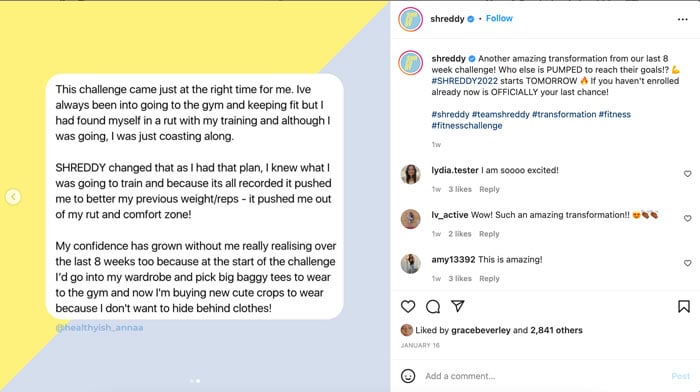
For example, fitness app Shreddy runs competitions asking users to share their progress over a specific time period. The person with the biggest transformation wins a cash prize.

Not only does it encourage users to sign up and use the app, but it motivates users to get the results the app can use as social proof.

How to Get User-Generated Content - Offer Incentives

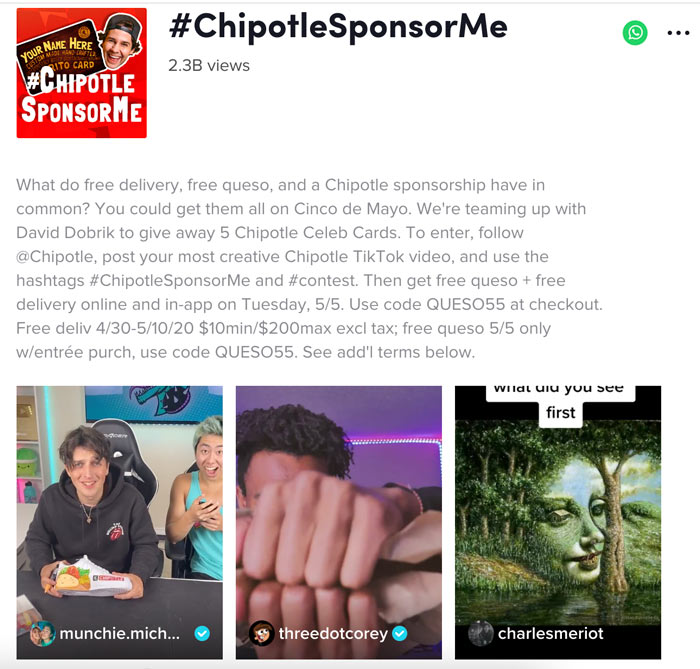
Chipotle did something similar with its TikTok campaign. The brand asked users to make a video explaining why they should win a free year of Chipotle using the hashtag #ChiptotleSponsorMe.

The result?

The brand hashtag received over 2.3 billion views.

How to Get User-Generated Content - Incentivize Customers With a Prize

Create Shareable Events

Social media is all about visuals.

Leverage this by creating beautiful and unique unboxing events, in-store spaces, and brand activation.

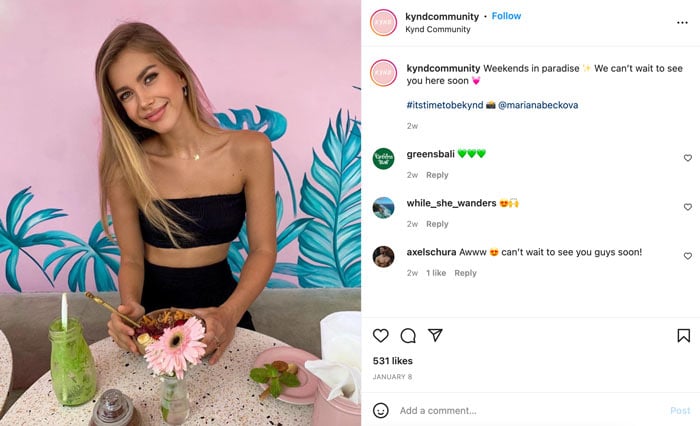
One of the best examples of this is Kynd Community in Bali. Thanks to its pink palm leaf wall and Insta-worthy smoothie bowls, the small cafe went viral on social media.

If you visit the cafe, you’ll often see customers lining up to take a photo in front of the famous wall, creating an endless stream of user-generated content and FOMO among travelers who want the same experience.

How to Get User-Generated Content - Create Shareable Events

How to Start Incorporating User-Generated Content in Your Content Marketing Efforts

Have you tried implementing UGC before but didn’t see results? Or are you just getting started and feeling a little overwhelmed?

Just like with any other marketing initiative, you need to have a clear plan on how you will achieve results with your new content efforts.

Here are a few things to keep in mind when creating your user-generated content strategy.

1. Decide on Your UGC Campaign Goals

Before you can start calling for and collecting content, you need to know exactly how you plan to use it.

  • Want to increase brand awareness? Create a hashtag like Audi’s #WantAnR8 campaign. A Twitter user started the hashtag, and the brand hopped on board to promote the launch. Soon other users took notice, and the hashtag was used 75,000 times.
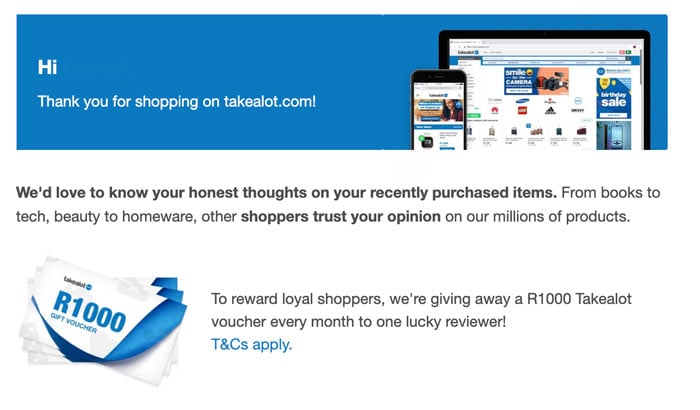
  • Want to increase conversions? Focus on a campaign that generates reviews and testimonials. Takealot, an online retailer in South Africa, offers users the chance to win a voucher for leaving reviews on recent purchases.
  • Want informative content that influences buying decisions? Take a page out of GoPro’s book and use UGC that shows the different ways your product or service can be used.
How to Start Incorporating User-Generated Content in Your Content Marketing Efforts - Decide on Your Campaign Goals

2. Brainstorm Which Type of UGC Will Help Meet Your Goals

Not every piece of user-generated content will work for each stages of the buyer’s journey.

In order to get consistent results, you need to analyze what works at each touchpoints and make changes accordingly.

Your UGC competition is perfect for creating top-of-funnel awareness while a user’s video review of your product works best for bottom-of-funnel conversions.

3. Use Different Types of User-Generated Content

You don’t need to post every type of user-generated content on each platform. Selectivity is key to any winning strategy.

Ask yourself what type of content is going to work best at each stage and test it out.

Let’s say you’re an online business coach ready to launch your next group coaching session. Testimonials and reviews are the types of UGC most likely to get results.

Collect testimonials regularly to add them to your content bank. This social proof can also be used in your emails, Instagram Stories, and landing pages.

Hotels are another good example of this strategy.

Reviews and testimonials are the perfect type of UGC for their booking and product pages. On the other hand, photos and videos of customers enjoying their stay would work really well on Instagram.

4. Find or Ask Users to Create UGC

If your brand has been around for a while, there’s a good chance users are already creating UGC.

Use a social listening tool to find what people are saying and implement the content into your marketing strategy.

Didn’t find anything?

Start asking your audience to create what you want. Encourage users to use your brand hashtag, incentivize reviews, and create campaigns centered around user-generated content.

Whatever you decide, make sure it’s clear to your audience what you want.

How to Start Incorporating User-Generated Content in Your Content Marketing Efforts - Find or Ask Users to Create UCG

4. Request Permission to Use the Content

Just because your brand is mentioned in a post doesn’t mean you can re-publish it without permission.

Always reach out and ask if you can use the content on your social media pages or website. Without permission, you might upset even your most loyal brand advocates.

Besides, when you reach out, it shows the user you like their content. They get those positive feelings while you get permission, everyone wins.

5. Always Credit the Original Creator

The most important rule of UGC is to always give credit where it’s due.

Don’t take someone else’s content and share it without tagging their account. That’s a big social media no-no.

Not crediting the original poster can also land you in hot water with your followers.

Plus, there’s an even bigger incentive to do it.

By tagging the creator, you show your followers that the UGC is authentic and wasn’t created by your team.

How to Start Incorporating User-Generated Content in Your Content Marketing Efforts - Always Credit the Original Creator

6. Promote Your User-Generated Content

Once your UGC starts rolling in, it’s time to start using it!

Schedule your photos and videos for Instagram and TikTok. Use the content to create ads on Facebook.

Share reviews on your next email blast and start adding your best testimonials to your sales pages.

The more you promote your UGC, the more you’ll incentivize your followers to participate.

A big part of UGC is the community. It brings you and your audience closer together and makes everyone feel like they are a part of something.

7. Track the Success of Your UGC Campaign

How do you know if your UGC campaign is successful? By tracking the following metrics:

  • number of impressions
  • total reach
  • organic traffic
  • social follows
  • engagement rate
  • total number of interactions
  • volume of posts created
  • total number of conversions
  • conversion rate
  • total revenue
  • total ad spend
  • click-through rates for ads
  • return on ad spend
  • growth of visual asset library

Monitor these KPIs throughout your campaign and make adjustments as needed to hit your goals.

Examples of Brands that Use UGC

Let’s put everything together and explore some of the best user-generated content campaigns that you can take inspiration from.

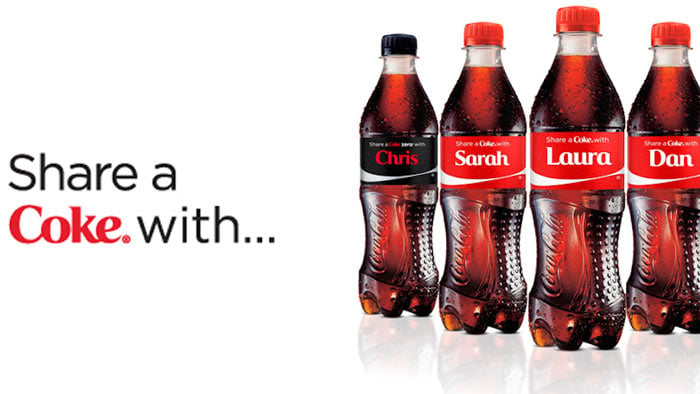
Coca Cola’s Share a Coke

Remember when Coca-Cola launched their “Share a Coke” campaign?

Featuring bottles named after people in every destination took the world by storm.

The brand asked customers to share photos of themselves with their personalized coke bottle resulting in 496,000 uses on Instagram and 89,000 tweets on Twitter.

Plus, more than 1.25 million teens tried the drink, and sales rose by sales rose by 11 percent in the United States.

Examples of Brands that Use UGC - Coca Cola

Burberry’s Art of the Trench

Over ten years ago, Burberry capitalized on the social media revolution with its UGC Art of the Trench campaign.

The brand asked its followers to upload pictures wearing their iconic trench coats. Burberry curated the best submissions and showcased their picks on Facebook and a dedicated microsite.

The results?

Burberry’s Facebook page grew to over a million and became the largest page in the luxury sector. Their ecommerce sales went up by 50 percent, and the microsite had 7.5 million views from 150 countries within the first year.

Lululemon #thesweatlife UGC Campaign

Lululemon is a yoga clothing brand known for its strong sense of community.

One of the reasons behind its billion-dollar success is the brand’s user-generated content. Lululemon launched a hashtag campaign to encourage brand partners and users to post pictures using their gear on Instagram.

#TheSweatLife campaign was a huge success. It hit $4.6 million EMV across 1.4k posts from 678 creators.

T-Mobile Break-Up Letters

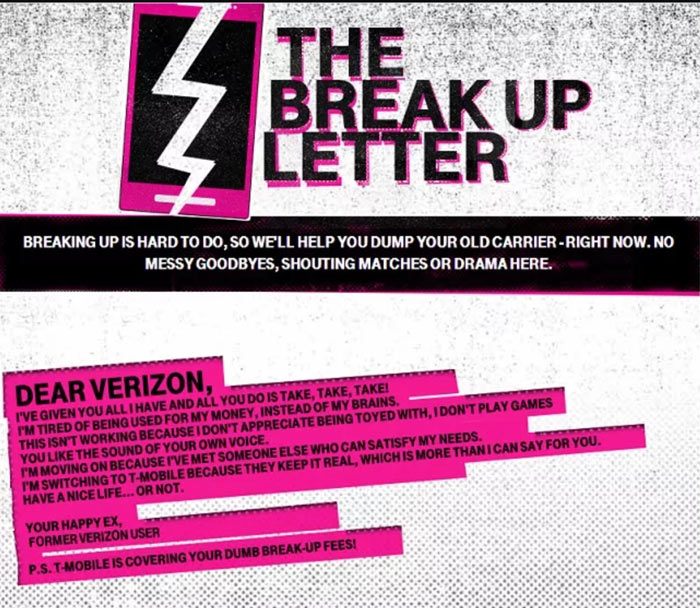
One of the greatest examples of a user-generated content campaign is T-Mobile’s break-up letters.

Mobile users didn’t want to switch carriers in the U.S. because of high cancellation fees.

T-Mobile’s solution? Encouraging people to submit break-up letters explaining their reason for leaving their current provider.

In exchange, T-Mobile would cover the termination costs.

More than 113,000 break-up letters were submitted, the app for the campaign received 2.7 million page views, and the campaign generated 67 million social media impressions.

This was topped off by T-Mobile’s CEO personally re-tweeting break-up letter posts and welcoming the new customers.

Examples of Brands that Use UGC - T-mobile

User-Generated Content Frequently Asked Questions

Do you have to pay for user-generated content?

No, you don’t need to pay for user-generated content. All you need to do is encourage your audience to create content featuring your product/service and tag your account in their posts. Don’t confuse UGC with sponsored ads from influencers.

Why is user-generated content used in marketing?

User-generated content is used in marketing because it’s powerful social proof. People trust recommendations from friends, family, and other humans online over the lip service of a brand. It humanizes your business and creates trust between you and your audience.

Do you have to get permission for user-generated content?

Yes. The best way to get permission for user-generated content is to ask. Reach out to the person in the DMs or the comment section and ask if you can repost their content on your profile.

What does user-generated content do?

User-generated content creates social proof. By posting content made by your customers, you’re increasing your credibility and showing potential customers your product/service will deliver on its promises.

Conclusion: User-Generated Content

Are you using social media to help drive your brand recognition?

Too many brands rely on their own content to drive social growth for their brand.

User-generated content not only takes a bit of pressure off of content creation demands but also builds credibility with your audience and naturally attracts more followers.

It’s time to think of user-generated content as an offensive strategy instead of being on defense against what people might say about your brand.

Be the kind of brand that people want to share with their peers and talk about on their social accounts.

How are you leveraging user-generated content to boost your social media footprint?


from Blog – Neil Patel https://ift.tt/vOBiYRJ
via IFTTT

Thursday, 3 February 2022

8 marketing campaign ideas that customers will engage with

Trouble coming up with marketing campaign ideas?

Hey, we hear you.

Growing your business and keeping revenue rolling in means consistently crafting posts and promotions.

But motivation can be hard to come by. This is especially true if your recent marketing push fell flat or your engagement rate is low.

The reality? Too many businesses are caught in a trap of ad-hoc marketing. That is, random promotions with no end-goal, strategy, or definition of “success.”

If you’re stuck or have no idea what to promote and publish next, we can help.

This guide breaks down how to put together meaningful marketing campaigns and plenty of examples to help you come up with fresh ideas.

What is a marketing campaign, exactly?

Let’s start by breaking down the basics.

The concept of a “campaign” is a staple of marketing itself but perhaps it doesn’t get talked about enough.

A marketing campaign is a promotional push or initiative carried out by a brand, typically tied to a big-picture business goal. Campaigns involve promoting content and creatives (think: ads, videos, photos, blog posts, copywriting) across various marketing channels (think: social media, email). 

Here’s a quick rundown of some of the most common goals that drive companies to come up with campaigns:

  • Boost brand awareness
  • Launch a new product or service
  • Improve customer engagement and satisfaction
  • Drive sales and revenue
  • Increase customer lifetime value (CLTV)
  • Reduce customer churn

When we think of classic marketing campaign examples (like “Got Milk?” or Nike’s “Just Do It“), we typically imagine TV spots, billboards and old-school print ads in magazines.

Now, fast forward to the present day. Campaigns are no longer reserved for corporate giants and ad departments. Given the wealth of digital tools and low-cost marketing channels like social media and email, businesses of all shapes and sizes can bring their marketing campaign ideas to life.

Note that a campaign is the sum of its parts. For example, a discount or sale is not a campaign, but a sale can be part of a revenue campaign. Similarly, posts and hashtags are not campaigns alone but can be part of a social media campaign. See how that works?

The common threads of “successful” marketing campaigns

Businesses today have a ton of creative freedom when it comes to promotions.

That said, there are three boxes to tick regardless of your business or ideas. Ideally, your marketing campaigns should be:

  • Time-sensitive. Campaigns don’t last forever! Conventional wisdom says it can take between two to three months to plan a serious campaign. The duration of your campaigns depends on the type of promotions you’re running. For example, a Black Friday campaign is short-term while a hashtag campaign is longer-term).
  • Measurable. Measuring your campaign performance data clues you in on whether or not your campaign was a hit based on your goals. If you don’t analyze your campaign based on relevant metrics, you’re winging it.
  • Unique. This is the big one. Marketing campaign ideas should be original and based on what your target audience wants. You obviously shouldn’t rehash campaigns you’ve run in the past or copycat other businesses.

What are the must-dos for modern marketing campaigns?

Arguably the biggest benefit of running a campaign versus ad-hoc marketing is that you’re focused. By tying your posts and promos back to specific goals, objectives and outcomes, you prevent yourself from freestyling.

That said, the planning phase of any given campaign is make-or-break.

Before you worry about coming up with any creatives, make sure you understand the tasks required to execute your marketing campaign ideas.

Establish relevant business goals

Simply put, what do you hope to achieve and how?

It’s no secret that goal-setting matters. Setting goals and tying them to specific objectives means you understand the smaller tasks that contribute to the big picture.

Example: We will raise brand awareness on Instagram by increasing our engagement rate by [x]% by [y end date] by running an Instagram influencer campaign

Chances are you’ve heard of the SMART framework for goal-setting. If not, here’s a quick breakdown:

  • Specific: Your goals should be clear, simple and defined.
  • Measurable: This is where analytics come in. You want a goal that has one or more metrics.
  • Achievable: Is it achievable or is it not possible within your resources?
  • Realistic: With your current resources of time and money, is it possible to achieve your goals?
  • Time-sensitive: Every goal needs a time frame, whether it’s one year or several months.

If you can define and answer the questions above, you’re on the right track.

Choose your priority marketing channels

There is no “right” answer in terms of where you promote your marketing campaigns.

Multi-channel marketing is both popular and proven for the sake of maximizing engagement. For example, publishing promotions to both social followers and email subscribers simultaneously makes your campaigns harder to miss.

That said, spreading your ideas across multiple channels requires a greater commitment of time and resources. Not to mention the rising cost of paid social media advertising.

If this is your first planned campaign, start with these two questions.

  1. Where do you have an existing marketing presence and customer engagement?
  2. Where can you realistically advertise based on your budget?

Note that some marketing channels lend themselves to easy cross-promotion (think: Facebook, Instagram and Twitter). This might make your choice easier, but when in doubt think “less is more.”

Pick the metrics and KPIs to measure your campaign

Again, successful marketing campaigns are driven by data.

Some of the most common metrics used to measure performance include:

  • Traffic
  • Sales and revenue figures
  • Event attendance
  • Engagement
  • “Likes” and clicks
  • Impressions
  • Reach
  • Referrals

There are a variety of social media metrics that are relevant to some campaigns but not others. For example, an ad campaign that netted you 10,000 new Facebook followers but $20 in sales isn’t much to be thrilled about.

Below is an example of analytics using Sprout Social’s reporting suite. Here you can see impressions, engagements and message link clicks over time. Based on this, you can better understand which pieces of your social campaign moved the needle.

Metrics tracked in Sprout Social can determine if your marketing campaign ideas actually succeeded.

Figure out your necessary resources and deliverables

In short, what do you need to make your marketing campaign ideas a reality? Consider key duties and deliverables for a campaign such as:

  • Graphics, logos and ad designs
  • Copywriting for ads, emails and landing pages
  • Keyword research
  • Social media posts
  • Product photos and videos

The more you anticipate in terms of your needs, the fewer roadblocks you’ll hit as you roll out your campaign.

Assemble your campaign collaborators

Sure, resources you may already have on hand or can create yourself.

But you’re likely going to need to outsource some of the legwork to outside collaborators, such as:

  • Email, social media and SEO experts
  • Graphic designers
  • Copywriters
  • Web designers

Whether that’s you rely on your teammates, an agency or freelancers ultimately depends on your timeline and budget. Either way, connect with these collaborators ASAP so you can align your schedules and get moving.

Set reasonable deadlines and milestones

Based on all of the factors above, you can create an actual roadmap for your campaign. This includes deadlines, deliverables and the “who’s who” of your marketing push.

Campaign timing can be a bit of a balancing act. The more time you give yourself and collaborators to prepare and plan, the better.

But on the flip side, you also don’t want to drag your feet. Communicating with teammates and collaborators to understand their own schedules and workloads is key to knowing what you can and can’t do.

This is where a project management tool like Asana (see below) comes in handy. Here you can see all the moving pieces of your campaigns in one place, including roles, deadlines and approvals.

Use Asana for marketing campaign organization and tracking across teams.

If you need help planning or deciding on a timeline, check out our social media campaign template that can help!

8 marketing campaign ideas you can roll out yourself

Alright, enough planning: let’s talk ideas!

Despite popular belief, you don’t have to be an advertising wizard to come up with marketing campaigns. There are more campaign ideas than we could possibly cover in this post.

Although this is good news, it might also serve as analysis paralysis if you’re not sure where to start.

That’s why we’ve decided to keep it simple. Below are eight engaging campaign ideas that businesses can adapt with a bit of creativity.

1. Keep customers informed with an educational campaign

Educational campaigns are a solid starting point to help drive sales and raise awareness with new and existing customers alike.

Creating resources such as instructional videos, blog posts and product demos allows you to educate and sell to your audience at the same time. These same resources are fair game across social posts, email, your website and even channels like YouTube.

For example, Ruroc recently paired a how-to video campaign with the launch of their Atlas 3.0. With a series of how-to videos and social posts, customers could see the product in action and likewise understand its key features and benefits.

Ruroc uses YouTube to create customer education marketing campaign.

2. Build a referral program from scratch

A long-term marketing campaign that’s ideal for ecommerce brands is creating a referral program. It’s a brilliant way to promote ongoing sales through your satisfied customers.

Offering discounts, trials and free bonuses to existing customers provide a much-needed incentive for them to refer new customers to you.

For bigger merchants, you can take this a step further with a full-blown brand advocacy program that encourages ongoing promotion of your products from dedicated customers.

Pura Vida's ambassador marketing campaign "How it Works" bannner.

3. Connect with influencers to raise brand awareness

Although influencer marketing is all the rage right now, some brands are still hesitant to get on board.

But with the rise of microinfluencers and influencer discovery platforms, getting connected to someone that’s in your budget and relevant to your audience is easier than ever.

From one-off campaigns to working with influencers at scale, these relationships are ideal for introducing your brand to new audiences.

4. Create buzz with a contest or giveaway

Giveaways and contests are among the most popular marketing campaign ideas on social media.

The upside of running contests or giveaways is that they have a built-in deadline or schedule. When brands push contests, that’s usually what they’re laser-focused on until the end date.

However, simply giving away a product on its own isn’t particularly engaging.

Well-crafted contests explicitly ask for engagements, including:

  • Follows
  • @mentions and @tags
  • Promoting a #hashtag
  • Creating content

Ideal for sign-ups and brand awareness versus sales, they can give you high returns when you consider what they cost. Just make sure you follow the legalese when it comes to entries and prizes.

5. Engage customers with a user-generated content campaign

User-generated content campaigns are a brilliant way to encourage customers to promote you organically.

Whether through a time-sensitive or ongoing customer #hashtag, you’d be surprised how many people are willing to share their photos and purchases if you just ask.

Stick Fix uses UGC marketing campaign on their Instagram profile.

6. Entice shoppers with holiday campaigns

Reality check: not all marketing ideas need to reinvent the wheel.

Take holiday campaigns, for example. Time-sensitive, color-coordinated campaigns centered around Thanksgiving, Black Friday or Christmas have been around forever. They’re even more popular in the era of ecommerce via email and social media.

Casper uses holiday campaigns around Black Friday hit revenue goals.


7. Hype up your next product launch

If you’re dropping a new product or service, building anticipation with a marketing campaign is a must-do.

Some low-hanging ideas to support your push and drive sales include:

  • Producing a high-quality launch video (see below)
  • Promoting pre-orders via email and social media
  • Putting a countdown timer on your website to build hype

8. Customer success campaign

Don’t overlook the value of your satisfied customers when it comes to your campaigns.

Customer success campaigns encourage you to reach out to buyers and leverage your relationships to create marketing materials for the future. Tasks involved in a successful campaign include:

  • Asking for and curating customer reviews
  • Promoting positive customer feedback through social media or email
  • Gathering case studies and testimonials from existing customers to win over new ones

3 bonus marketing campaign examples to get inspired

Feeling motivated now?

We actually have a whole list of social media ideas to help you keep the momentum going.

But to wrap things up here, let’s look at some recent examples of effective marketing campaign ideas put into action.

#SpotifyWrapped (UGC/hashtag campaign)

Spotify’s #SpotifyWrapped has taken social media by storm over the past few years, representing one of the best marketing campaigns in recent memory.

A hybrid UGC and hashtag campaign, Spotify encourages users to share their most-listened-to artists and tracks every December. This personalized data packaged in a stylish, share-friendly format has resulted in millions of social shares and engagements.

This again highlights the fact that people are eager to share content when prompted. Whenever you can let your customers do the legwork of marketing for you, go for it.

Headspace (paid Facebook ad campaign)

Facebook has no shortage of advertising success stories from brands running paid ads.

This simple but effective example comes from Headspace with its colorful video ad campaign.

The animation ad below managed to not only capture the brand’s voice but also serve as a sort of taste of their product via soothing text and audio.


Headspace Facebook ad campaign resonates with customers with a simple, clean design.

The end result was an impressive list in awareness, recall and interactions. Headspace’s campaign highlights that campaigns don’t have to be ground-breaking or complicated to be effective. This speaks to the value of both knowing your target audience and harnessing your creativity.

Gymshark (Black Friday and product launch campaign)

Infamous for rarely running sales, Gymshark’s 2018 Black Friday campaign reached a staggering 16+ million people on Instagram and boasted a 6.6:1 return rate on their ad spend.

Gymshark Blackout ad for Black Friday caused a buzz in 2018.

Wild, right? The brand leveraged the buzz by building anticipation for the event and dropping a fresh fit alongside it.

This signals the importance of both branding and planning. Creating buzz around your campaigns is crucial, as is delivering campaigns like this that feel one-of-a-kind.

What does your next marketing campaign look like?

No matter what you’re selling, you need to brainstorm new marketing campaign ideas on a regular basis.

Hopefully this guide inspired you to do exactly that!

But beyond ideas, you also need to understand best practices for executing your campaigns.

If you haven’t already, check out the latest Sprout Social Index, Edition XVII: Accelerate to see the latest trends, insights and data you need to take your campaigns to the next level.

The post 8 marketing campaign ideas that customers will engage with appeared first on Sprout Social.


from Sprout Social https://ift.tt/2Bf3AIp
via IFTTT