Twitter announced Wednesday that users can now add their Ethereum wallet addresses to their profiles as part of the social media giant's iOS and Android Tips payment feature. Tips lets Twitter users add public-facing payment methods to their accounts, so that users can (as the name suggests) send tips or payments to others on the platform.
Up until today, Twitter had included traditional payment apps like Cash App in Tips, as well as the less traditional Bitcoin wallet addresses.
Notably, former Twitter CEO Jack Dorsey is considered by many in the cryptocurrency space to be a Bitcoin Maximalist. That is, he has historically been all in on Bitcoin, while dismissing other cryptocurrencies like Ethereum.
When asked, a Twitter spokesperson denied Dorsey's recent departure has anything to do with Twitter finally adding Ethereum to its Tips feature. A coincidence, surely.
Indeed, despite Dorsey's professed passion for Bitcoin, Twitter has been slowly and steadily welcoming Ethereum with open arms. In January of this year (less than two months after Dorsey's departure), Twitter announced users could link NFTs — as long as they lived on the Ethereum blockchain — to their user profile pics. And in June of 2021, Twitter gave away NFTs minted on the Ethereum blockchain.
So it's not like Wednesday's Tips announcement is totally out of the blue. Still, the timing sure is funny.
The YouTube algorithm is designed to help viewers find videos they want to watch and maximize long-term viewer satisfaction. Similar to other social media platforms, YouTube’s algorithm has changed as the site has evolved.
In 2020, 74% of US adults said they had used YouTube, beating out all other social networks. The next highest usage was Facebook at 68%.
With such a dominating presence, of course we want to understand how the YouTube algorithm works. Read on to learn more about the algorithm and how to up your YouTube marketing strategy.
The YouTube algorithm before 2022
YouTube has significantly adjusted its algorithm a few times in its history. As a result, these changes had a direct impact on the videos that were posted and how users came across them.
2005-2011: Clicks & views
In its early years, YouTube was all about how many eyes were on a video and how many people clicked through to watch it. In 2006, Nike’s Ronaldinho ad became the first video to reach 1 million views on the platform. Then in 2008, the Evolution of Dance video was the first to reach 100 million views. However, because clicks and views were so highly valued, clickbait videos dominated the platform, pushing away user interest.
2012: Watch time
In 2012, YouTube announced a new metric “Time Watched” to use in their search and Suggested Video algorithm. YouTube decided the videos people were spending more time watching should be more valued in its algorithm.
2015-2016: Satisfaction & personalization
In 2016, YouTube released a paper on its algorithm for its recommendation systems. According to the paper, the user’s watch history, search history and video completion history – all contributed to producing recommendations that were more personalized than ever. Moreover, the company used surveys to collect information on what users enjoyed and preferred.
2016-present: Demonetization & policy updates
Although demonetization was in effect since 2012, the platform did not start notifying content creators about their violations of content guidelines until 2016. Ads were running alongside videos that promoted offensive or violent content, leading many major companies to pull their advertising. YouTube further updated its algorithm to have stricter policies on ads and tightened its eligibility requirements into the Partner Program.
How does the YouTube algorithm work today?
In 2021, YouTube gave more insight into its algorithm and how its recommendations system works. Above all, YouTube wants viewers to enjoy the videos and stay on the platform as long as possible.
YouTube uses three main categories to personalize recommendations:
Personalization: user watch history and action
Performance: interest in watching the video, view duration, satisfaction
External factors: topical interests, how your competition is performing, relevancy to the current season
There are seven areas on YouTube where the algorithm has an effect. Let’s have a closer look at what each one entails.
1. Home
Home is the first place that someone lands on when they open up YouTube and is one of the top traffic sources for most channels. The more you use YouTube and interact with videos, the more personalized your Home will be. In addition, your channel subscriptions show up here as well.
The ranking for Home is based on two factors:
Performance: Based on the demographics data they’ve collected about you, they’ll show videos that have engaged and satisfied viewers similar to you
Personalization: Your own watch history, channel views and topic interests
Home algorithm tips for marketers
Below are a few tips from YouTube on optimizing your video to show up on someone’s Home page:
Pretend you’re a new viewer to your channel and objectively review your videos. Would you want to watch them?
Upload consistently to create expectations from your viewers
Do what works for you. Create content in a similar style or topic to ones that your viewers already enjoyed.
Check your YouTube Analytics Traffic Sources to see how often your channel is appearing on others’ Home pages
2. Suggested Videos
Suggested Videos are what show up in the sidebar when you’re watching a video. If you let your current video finish playing, a suggested video is what automatically plays next.
How the videos relate to each other as a common topic
A user’s own watch history
Suggested Videos algorithm tips for marketers
To optimize the algorithm recommending your videos, utilize some of the below tips:
Create a series: publish videos that are related to each other. Don’t forget to turn it into a playlist.
Pay attention to your ending. YouTube has features like playlists, links, cards, end screens and call-to-action buttons to help you guide the viewer to another of your videos
Create videos in formats that are currently trending
Have consistent title and thumbnail styles for your videos
3. Search
The YouTube search engine is powerful. After all, the platform is owned by Google. Keep in mind that search results are not entirely based on videos with the most views, so understanding YouTube SEO can help you rank higher.
Relevancy: How well do the keywords relate to what matches in the title, description and video content
Engagement: Videos that have had the most engagement as related to the search query
Watch time: Videos that have driven the most watch time as they relate to the search query
Search algorithm tips for marketers
There are quite a few ways to optimize your videos for showing up in the search results. While it may be tempting, stuffing your descriptions full of keywords is not the way to go.
Research what keywords users are typing to find your videos
Check your Trending tab to see what video and topic ideas might fit into your channel
4. Trending
YouTube’s Trending tab compiles the most popular videos of the moment as well as identifies creators that are gaining in popularity. These results are specific to the user’s country and aim to combine popularity with novelty. For example, the Creator On The Rise and Artist On The Rise sections feature up-and-coming channels and are updated daily.
The Trending tab takes note of the following attributes:
View count
Rate of growth in views
Where the views are coming from (location)
Trending algorithm tips for marketers
Showing up in a Trending tab is a big win for many marketers. But you can’t pay your way into showing up there, you can only try and make videos that might fit there. Here are some tips:
Make broadly appealing, shareable videos. That means making videos that will appeal to a wide variety of people, not just your subscribers.
Check your analytics to see how often your videos are appearing in the Trending tab
Be consistent in quality and schedule. To be qualified for the Creator and Artist On The Rise sections, you’ll need to reach a certain subscriber level and meet other metrics like growth in views and subscribers.
5. Subscribers & Subscriptions tab
Subscribers are viewers that opted in to see more content from you. When someone subscribes to your channel, your videos appear in their Subscriptions tab. Subscribers are your biggest fans and provide the most engagement on your videos. In addition, video subscriptions also show up on the Home page.
Subscriber tips for marketers
Increasing subscriber counts is a primary goal for many YouTube channels. To do this, there are a few tips that YouTube offers:
Ask for viewers to subscribe at the highest points of engagement or emotion in a video and at the end
Be genuine in why subscribing is important. Educate your viewers on why subscriber counts matter to you and your channel.
Check on your subscriber count in analytics and create videos similar to those that have performed well. Using Sprout’s YouTube Analytics, you’ll be able to discover insights that drive video longevity and benchmark your existing videos.
6. Notifications
Notifications are alerts sent to a user either via push or email. The default for notifications is from channels you watch often or those you’ve subscribed to. Users can edit the frequency of notifications from the subscribe button.
There is a limit to notifications, though. Viewers will receive a maximum of three per upload/livestream per channel within a 24-hour period.
Notification tips for marketers
Notifications are a great way to inform your subscribers of new content that you produce. To encourage subscribers to turn on notifications, use these tips:
Subscribe and be notified by other channels so you can understand how they work from the subscriber’s point of view.
Check your analytics to see how much watch time is produced from videos that appeared in notifications.
Encourage and explain notifications to your viewers.
Publish videos at optimal times for your viewers.
7. Restricted Mode
Restricted mode is an optional feature on YouTube you can use to filter out potentially mature content. This mode must be turned on for it to take effect. To see if your videos appear in Restricted Mode, you’ll need to turn it on and visit your videos directly.
Myths about YouTube’s algorithm have existed for a long time. Here are the most common ones, debunked:
Myth 1. Uploading videos as unlisted and then changing them to public will affect the algorithm.
Truth: The algorithm does not penalize this. Instead, it looks at how a video performs after you publish it.
Myth 2. Optimizing your titles and descriptions will get you to rank higher in the algorithm.
Truth: SEO is not the only signal that the algorithm considers. Optimizing your video SEO will help but the algorithm takes into account a lot of other factors.
Myth 3. It would be better if the Subscribers feed was the default instead of Home.
Truth: YouTube has tested this and found that it reduces the number of subscribers who come back and watch on the platform.
Myth 4. Subscribers receive all notifications for all the new uploads.
Truth: Subscribers need to opt-in for notifications in order to receive them.
Conquer the YouTube algorithm
The YouTube algorithm isn’t fully transparent, but there is still some information out there on how it works. We know that the algorithm has changed through the years, from valuing view numbers to personalizing the home feed. We also know that it plays a role in various areas on YouTube, including Home, Suggested, Subscriptions and more. Now that you know more about how the YouTube algorithm works, the next big step is understanding how consumers are using social media and how you can stand out from the crowd.
Last year, TikTokker Avery Steeves posted a video asking why no one talks about how there's an entire generation of teenage girls who taught themselves to code HTML on Tumblr. "People are like, 'Oh, there's no girls in STEM,'" she says, imitating the faceless internet mob. "No, there were! They were just making pale blogs," an emblem of the washed-out, soft-grunge aesthetic popular on the platform in 2014.
The comments section bloomed with notes from women who credited Tumblr with jump-starting their careers in technology: "I wrote my college app essay on learning to code on Tumblr and got accepted into college for a cs [computer science] degree," wrote one; "And now I project manage website design," said another.
As typical of most online discourse, there were also some replies sneering with disdain: "Front end is not actual coding you know," a user commented, alongside scornful remarks like "Html/css isn't really coding just saying."
I asked Maxine Hood, a 25-year-old Software Engineer at YouTube, what she thought about those comments. "That's like looking at the sky and being like, 'The sky isn't blue. How can you say it's blue?'" she laughs. "That's a ridiculous statement trying to demean teenage girls [and keep them] from getting credit for doing something difficult… HTML is a coding language. It is coding."
From 2011 to 2015, Hood ran a fan Tumblr for South Korean girl group f(x). "My youth was being a fan of f(x) and running this fan site specifically for [f(x) member] Victoria. I worked really hard to try to be the best Victoria fan page on the site. You could do a lot with the Tumblr themes back then, they gave me so much control with editing the HTML."
As a 14-year-old, "I had no experience coding at all," Hood says, "so what I remember doing was copying the HTML from a different theme someone had posted and then going in and making changes to the color or trying to add plugins or APIs [an interface that enables two applications to talk to each other]." She would often update the theme to match the aesthetics of f(x)'s latest musical release. "I remember really struggling adding this chat box feature. I eventually got it working, but it was only in the bottom right corner when you scrolled all the way down. That was my first experience in the programming world."
Hood's high school didn't offer computer science classes, but in her first semester at Wellesley College she signed up for an introductory course that would set her on a path to majoring in the subject. "I knew I'd be interested in it because of my coding on Tumblr," she says, "without editing themes, I don't know if I would have been."
HTML is a coding language. It is coding.
Dimitra Zuccarelli, 26, owes her career to Tumblr, too. She joined the platform around 2009, using it first as "a proper blog" before the site evolved into the photo-and-GIF-rich multimedia mecca that is "the Tumblr that we know now." When it came to coding, the arctic-themed multiplayer game "Club Penguin was literally my origin story," she says, but Tumblr opened up a different world of possibilities.
"I was so obsessed," she adds. "It was very formative for me and a lot of other people. It was the equivalent to what TikTok is now for the younger generation: a free space to learn about your style and your interests. I had a strong sense of style, and I really wanted to express that."
Zuccarelli and her identical twin sister Milena "grew up on Tumblr together. She would design [themes] on Photoshop, and then I would go off and code them," Zuccarelli recalls. "As a teenager, I was very, very, very tunnel visioned. If I wanted to do something, I was going to figure it out… I basically just put my head down Googling everything…going into the source code of other people's websites, copying and pasting everything, and then literally just going line by line, deleting stuff, copying small bits, seeing what that would do. By tweaking something here, how would that look on the page? It was a lot of trial and error, but I would come home after school every single day and work on it to the point where you start to see patterns, and it becomes second nature.
"Once you understand how something works, then it's kind of easy to start applying those principles to something from scratch."
Zuccarelli says she and her sister excelled in a style of template that was "niche at the time, very minimalistic. It was hard to find stuff that fit exactly that aesthetic." They began selling HTML templates and opened a small business building websites. Then, "I started to realize that while I did really enjoy designing the websites, understanding how the [programing language] PHP in WordPress themes worked was way more interesting to me," she remembers. "I absolutely loved the logic side of it… and that's when I realized that I could go into coding as a career. I knew because I spent my life on the computer and was chronically online that it would be a good career path."
It was a lot of trial and error, but I would come home after school every single day and work on it.
Zuccarelli now works in backend development for a fintech startup in London, while her sister, who studied interactive design at Glasgow School of Art, works in front-end engineering. Zuccarelli says learning to code on Tumblr is now a badge of honor she finds "hilarious."
"I didn't used to tell people [about learning on Tumblr] because, up until a few years ago, it had so much stigma," she explains. "Like, 'Oh my gosh, you were on Tumblr, you're like an SJW snowflake who had an eating disorder.' There's loads of stereotypes attached to it. Now I think I wouldn't be embarrassed at all."
She sees Tumblr as a rich soil for formative creative growth — if you have the time to invest. "I would spend so much time just doing research and discovering new things and learning about photography and graphic design and user experience. I wish I had that again because I miss being able to just dive head on into things that I'm interested in. It's harder now with a nine-to-five."
For 23-year-old Shanaia Ramirez, coding was her main creative outlet. "I can't draw, I can't paint…my creative side comes out with coding," she says. She joined Tumblr in sixth grade, in 2010 or 2011, lured by the One Direction (she's a Zayn girl) and Percy Jackson fandoms. Ramirez dabbled in HTML editing to create Hogwarts houses widgets and themes dotted with carrots, an early inside joke within the Directioner fandom later deigned cringey.
But things got serious with "the rise of aesthetic Tumblr" when "everything was minimalist, everything was beige," she laughs, and she chased after a "cleaner look and better flow." Ironically, "I was able to get more creative with minimalism: make the colors pretty, the transitions, the effects, when I repost, when I hover over posts," she tells me, her voice warm with memories. "I got addicted to learning… And when I couldn't solve a problem, it would irk me. I'd do research outside of Tumblr, 'How does HTML work?'"
In high school, Ramirez abandoned Tumblr to pour her energy into studying and college applications. "I'm Asian. So you know there's a whole stereotype about going into nursing…" but she didn't think a career in healthcare was the right fit. When she asked herself, "What did I do before this when I had time?" — the answer felt natural: "I love technology. Why not code?" It satiated her need for constant change and evolution. "I get bored easily [but] with comp sci you have to keep up. I'm always learning. It's always changing."
She's learned programming languages Java, C, C++ and is working on mastering Python. "It's always different every day, there's always some new language. I can't get bored."
Ramirez will graduate with a degree in computer science this year from California State University San Marcos. It can be a lonely trail to blaze, but she says being one of just a handful of women in her major pushed her to stick with it. "You can count how many girls are in my class on one hand. I would step foot into a coding class and all the men, they'd look at me like, 'Oh, girl, are you lost?' I'm like, 'No, I'm actually here to do the same thing you're doing.'"
At the end of my call with Hood, I christened this mini phenomenon the "Tumblr girl-to-engineer pipeline." But then I backtracked — maybe "Tumblr girl" felt reductive. "Oh, you can call me that!" Hood assured me, proudly. "I'm fine being called a Tumblr girl."
But if you’re fantasizing about working four hours a week on a beach and making twice the amount of money, you’re in for a shock. This career takes time and work.
Let’s break down ways to become a successful social media consultant and how to get started.
Something something personal news: Tomorrow’s my last day at @WeAreOwnUp + next week, I’ll be starting work as a full-time freelancer. I’m excited + terrified!
If you need writing, social, or marketing/comms help, I’m taking clients! You can reach me at hello@nicoletabak.com ✌🏻
Social media consultants are individuals or agencies who work with clients to improve upon, optimize and grow their social media presence. Every social media consultant’s day-to-day work will look different depending on their offerings, which can range from one service to multiple. We’ll go over these a little later.
What are the pros and cons of being a social media consultant?
With self-set hours and locations, you have more flexibility as a consultant. And according to recent data, consultants and freelancers can have higher earning potential and a wider salary range than other social media professions.
But remember—you’ll be a business owner. That means unless you have the money to outsource, you have to do the accounting, billing, tax payments, marketing, sales pitches, content development and networking (i.e., all of the tasks that keep a business running).
If this sounds like something you’re interested in, follow these seven tips to help you become a successful social media consultant.
1. Do your research
Just like starting any new business, researching your industry, pricing and potential client base is key.
Saying that you’ll offer consulting services is not enough—creating a business plan helps you work through how you’ll generate revenue.
Research your potential competitors through LinkedIn and Google searches. Who comes up when you search “social media consultant Houston” or “hospitality social media consultant?” What services do they offer? Do you have the skills needed to be a social media manager working solo?
2. Decide on services and specialty
Niche or general?
This is a constant battle for consultants. Is your goal to handle social media marketing for any company or to specialize in specific industries that you’re passionate about? There are pros and cons to both.
For Jen Thorne, London-based social media consultant and beauty blogger, the key is ensuring you have enough business. “Whilst niche is good, you want to make sure you can generate enough ongoing work.”
During the research process, look at both what you want to offer and the matching client base. For example, if you only want to handle social media marketing for restaurants, look at the restaurants around you to see if any need help.
If you want to specialize in pizza restaurants, how broad is the addressable market for your services? How will you stand out from others offering the same expertise?
Services
The scope of a social media consultant is vast.
Oftentimes, the role overlaps with SEO, content creation and social media strategy. As a consultant, you have many choices of offerings. Here are just a few:
Providing a mix of products and services allows you to diversify your income stream. But having too many can also be prohibitive, splitting your focus.
Whichever you choose, be sure to be as specific as possible on what you will do for your client and how work will be delivered. Setting boundaries is key in any healthy relationship.
Pro tip: Whether you’re niche or general, using social listening can help direct you to the audiences and conversations that matter most to you and your client.
Setting your fees
Deciding on fees can be challenging. In your research phase, take time to look at what other consultants are charging.
“Personally, I prefer charging by the project vs. by the hour. In my world of content creation, assignments can take a few hours or a few days, so per project rates are what work for me,” says Nicole Tabak, freelance copywriter, content creator and brain behind the Social Media Detox newsletter. “I suggest laying this all out in a spreadsheet and breaking that down into your hourly and project rates.”
Jen tells us, “A good starting point is to find your goal salary and work out your day rate from there (salary, divided by number of days you anticipate working each year, allowing for holiday/sick days).”
The most consistent tip we heard from freelancers and consultants was to value your worth. As social media professional and podcaster Jon-Stephen Stansel puts it, “It’s tempting to shoot low, but this will hurt you in the long run and attract clients who are just looking for a good deal.”
Pro tip: Remember to build your expenses and self-employment taxes into your pricing. Freelance rate calculators can help you decide.
3. Get organized on the administrative side
Beyond setting up your physical workspace, there are processes and workflows that you need to establish to run a smooth consulting operation. This includes finding the right people or software to handle invoices, client appointments, insurance, quarterly tax payments and more.
The best way to set up a client intake process is to picture yourself as the client. Document every step in detail.
Prospecting: How do clients find you? How do they book a consultation with you?
Proposal: Will you send out a proposal? What are the steps for review and approval?
Contract: Do you have your contracting system set up? Is it easy to understand and how do they sign?
Onboarding: How do you officially start working with the client? Do you need to give them access to your invoicing software? Do you need to collect social account password information?
Invoicing: How do you deliver invoices and how do you want to be paid? Is your client clear on your payment terms and late fees?
If you can afford it, consider enlisting an accountant. As Jon-Stephen tells us, “You might not think you need one when you first start out but it will make your life immensely easier if you hire an accountant on day one.”
In the words of Adrienne Sheares, social media consultancy owner, “I’d rather my accountant try to be a social media marketer than me try to navigate the U.S. tax system.”
She also emphasizes the importance of putting protective processes in place early. “Having insurance, separate bank accounts, and an LLC can give you much-needed protection from lawsuits.”
Take time to set yourself up for success on the business side before diving in.
Pro tip: We want to all believe that people will pay on time and stick to an agreement. Unfortunately, as a small business owner you need to protect yourself—contracts are the best way of doing so.
4. Secure the right tools
Your time is precious. Build out your tech tool belt with software programs that can automate some of your processes. A social media management platform, analytics program, content calendar and invoicing app, to name a few, can be life savers.
If you plan on offering analytics in your services, you’ll need to decide if you’re going to put together your own reports or generate them with a tool.
A tool like Sprout that pulls data and creates sharable, presentation-ready reports for you can save hours of time.
5. Start small
For some, it’s a slow transition from working a 9-5 while building their side hustle to becoming a full-time consultant—especially if you’re not 100% sure this is the job for you.
Taking on one or two clients at the beginning gives you the safety net of your current job while figuring out your ideal role. If you’re having trouble finding your first clients, here are some places to look:
Putting myself & my services out there as I continue to navigate through freelance! Appreciate how supportive Twitter can be so please share if you know anyone needing…
– content creation/UGC ads
– branding/design
– social media help (mngmt, engagement etc. – all platforms)
Pro tip: When you have multiple clients, keeping yourself organized is key. Take this time to experiment with your workflows and how you manage work for each client.
With Sprout Social, you can organize your clients intoGroups where your publishing calendar, reports and more are all dedicated to one specific client. Many agencies that use Sprout, for example, use this system to organize multiple clients.
6. Put yourself out there
Practice what you preach
A good part of your time as a consultant involves self-promotion and establishing expertise. No one will hire someone who can’t demonstrate that they know what they’re talking about.
Set up a website featuring case studies and past work, and keep up with your social channels. Potential clients will research your pages—you don’t want them to see that you haven’t Tweeted in two months.
A prospect told me recently:
"I didn't need to look too deep at your portfolio; I looked through your tweets and that was good enough for me."
Every tweet and interaction is a portfolio piece. Your presence here can/should build your cred & do much of the selling for you.
Building your network of industry professionals can be just as important as building your client base.
Jon-Stephen considers networking part of the job. “Schedule some time each day to dive into conversations on Twitter and LinkedIn, write your own posts and build yourself up as an expert in your field. Make it a habit like exercise.”
Your network can also help connect you with clients.
Nat also was a huge help to me last year, taking the time to give me some thoughts, advice, and kind words. I can't say enough good things about her.
If you're looking for a freelance social media manager who really knows their stuff, Nat is an absolute gem! https://t.co/EUwRCh5OwL
Nicole tells us that thanks to her network, she landed clients as soon as she started freelancing. She also mentioned that networking can look different for everyone—from events to digital spaces—and to start where you’re comfortable.
“For me, I enjoy networking most through social media. Most of my leads have come from building a community on Twitter—a huge area of opportunity for anyone in marketing across different levels and niches.”
The more you engage with fellow consultants, the more they recognize you as an expert.
Let's talk about freelance contracts!🗒
Many freelancers have been burnt by not having a freelance contract. Until they discovered the importance of a contract.
Join us as we talk about what makes up a freelance contract on Freelance Tales by 6:00 PM NGT. https://t.co/qgprOOvgs5
Adrienne spent the first few years in her consulting business acting like an external employee rather than a consultant, and following her clients’ lead.
“This mentality would make me a stellar employee. However, it was horrible for my business, mainly because it hindered my growth. I worked all of the time for clients, and when it came to working on my own business, I was exhausted.”
Keeping up with your clients doesn’t mean you have to be constantly on. You don’t have to answer emails within five minutes to be a great communicator. The better your communication and the smoother your workflows, the easier the rapport will be.
Setting boundaries and prioritizing time for yourself also doesn’t have to mean taking a month-long vacation right away.
“I’d recommend starting with easy, simple things,” says Nicole. “Take an actual lunch break. Don’t jump on every notification that comes in. You can easily feel like every client and every project is a priority, but at the end of the day you control your own time.”
Ready to be a social media consultant?
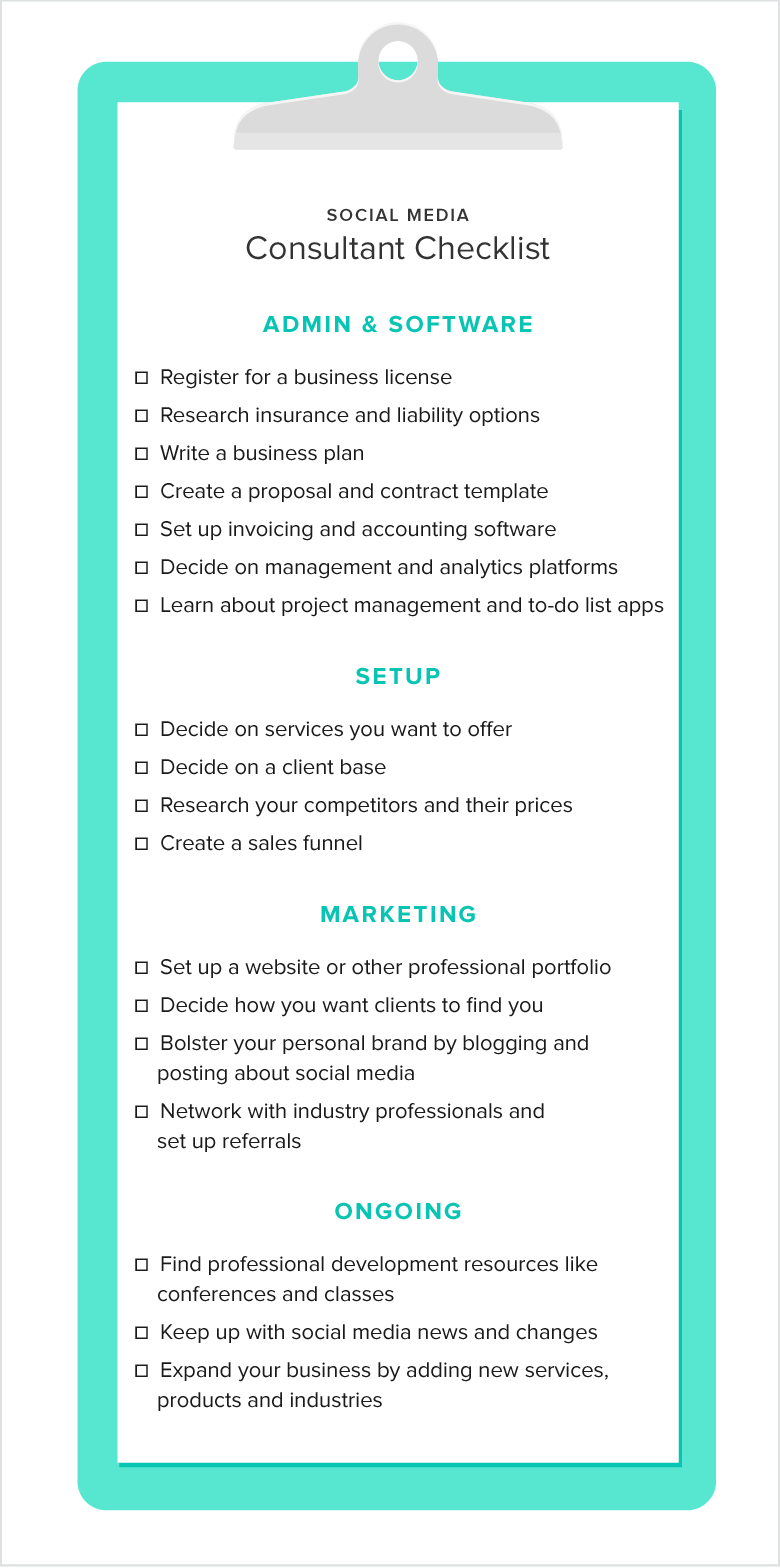
It may not be easy, but becoming a social media consultant can be incredibly rewarding. If you think this is the job for you, do your research and follow our social media consultant checklist below to start strong.
It’s frowned upon to build links through guest posts.
If you do, they should be nofollowed and ideally, you should be guest posting for brand awareness and referral traffic.
Even though that’s what I follow, it doesn’t mean others do.
Plus, I get hundreds of emails a day asking me if I accept guest posts, hence I know it’s still a popular link building method (although I ignore all those emails).
What Kind of Sites Did We Analyze?
First off, not all blogs accept guest posts. So, if a blog didn’t accept a guest post, we clearly didn’t include it in our study.
Second, we looked at sites that clearly labeled content as a guest post or as a post written by a guest author or guest contributor.
Third, we looked at sites that used dofollow links in the guest posts (even though they should have been nofollowed) to see if they had an impact on rankings.
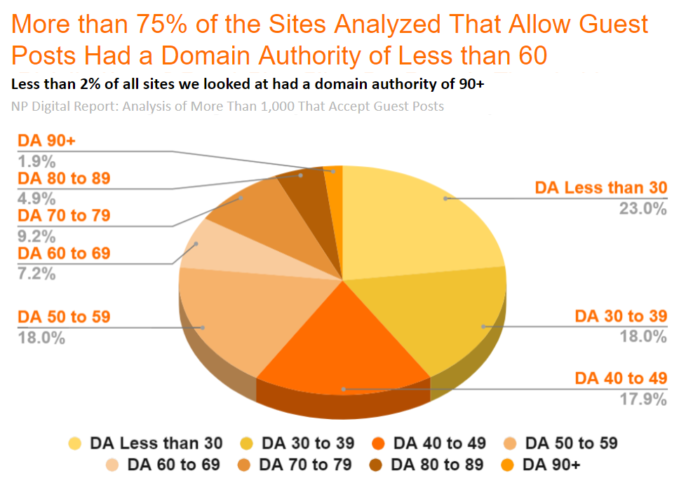
As you can see from the graph above, we looked at sites across different domain authority levels. We wanted to see what impact it had on whether a guest post received traction or not.
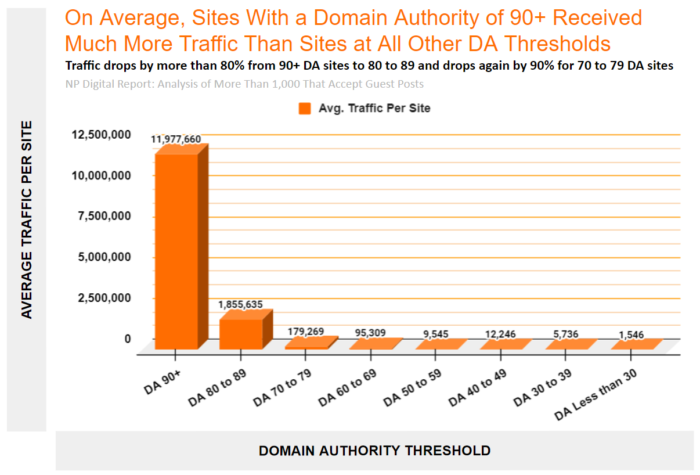
We also looked at sites with varied traffic ranges to see where posts might perform best.
As you can see, targeting sites with a domain authority above 90 will likely lead to more traffic. At the same time, those are also the sites that will be hardest to get links from.
I know that isn’t a clear answer, but it is if you read the rest of the post. Because there are certain types of guest post links that work and there are others that don’t.
Here are some more insights…
Too Many External Links Is Bad
Some guest posting sites link out a lot.
Some don’t link out too much.
Although you shouldn’t be focusing on how many times you do or don’t link out, you should be focusing on providing the best user experience to your audience. If that means including a relevant link to another site in your article, by all means, link out.
If it doesn’t make sense, then you shouldn’t.
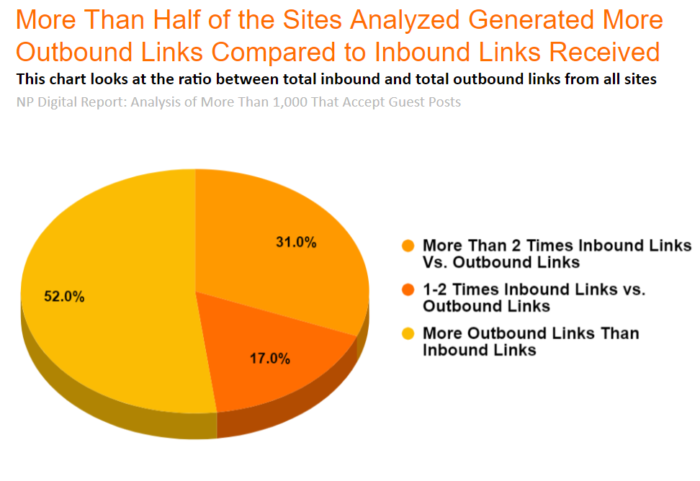
Look at this chart.
Now, it’s hard to know for sure if a link received from a guest blog site with more outbound links than inbound links is effective since websites don’t just have 1 backlink. Most websites can have hundreds and, in some cases, millions of them.
Just look at my site NeilPatel.com. Sadly some spammy websites link to me (scrapper sites) and some high authority websites link to me. It’s hard to know for sure what the impact a spammy site link has on my rankings compared to the ones received from high domain authority sites.
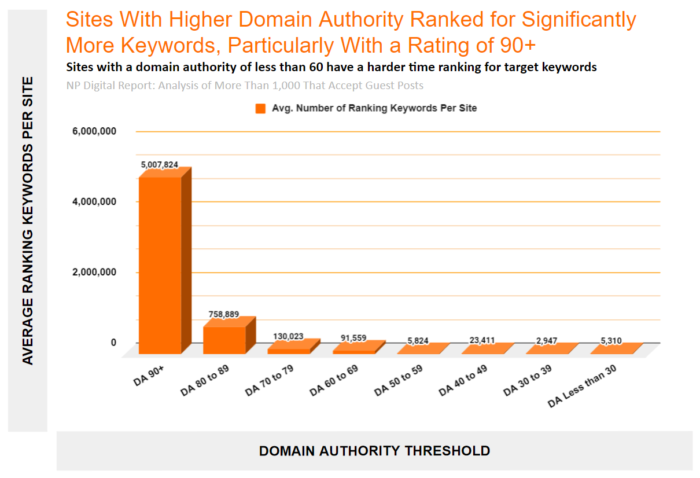
Instead, what we could do is look at the number of keywords a guest posting site ranks for. In theory, the more keywords a site ranks for, the better they are since they are liked by Google. I would think that a link from them would be more favorable.
What you’ll notice is, generally speaking, the higher domain authority a site has, the more keywords it ranks for. But we already knew that.
When looking at the domain authority range from 0 to 59, you’ll notice that there isn’t a consistent upward trend. That’s because many of the domains from our analysis in this range tended to be sites that were expired or bought-out and are mainly used for guest posting purposes.
Even more interesting. The guest posting sites that had more external links than inbound links all had a domain authority of less than 60.
From this one insight, someone could infer that you should aim to get links from sites that have more inbound links than external links. As in, sites that have higher domain authority.
You should also avoid guest posting sites that exist for the sole purpose of linking out to other sites. These can be considered spam links.
The Right Links Help
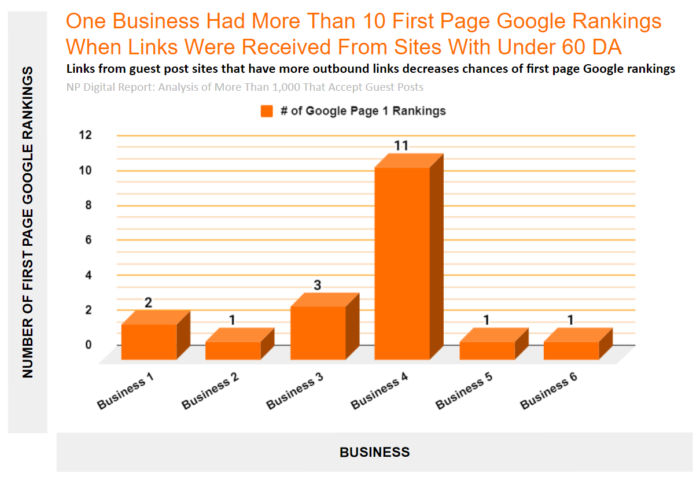
From all of the guest posting sites we analyzed, we found 14 businesses that were exclusively receiving links from some of the sites we looked at. Of these 14 businesses, six of them only received links from guest posting sites with a domain authority of less than 60.
In other words, they didn’t have links from any other sites.
So, we dove into their rankings and traffic.
What’s funny is that these six businesses had little to no rankings or traffic.
Since these six businesses only received links from spammy guest posting sites, we know that each of those sites had more outbound than inbound links. It’s clear that those sites didn’t really serve a purpose other than for guest posting.
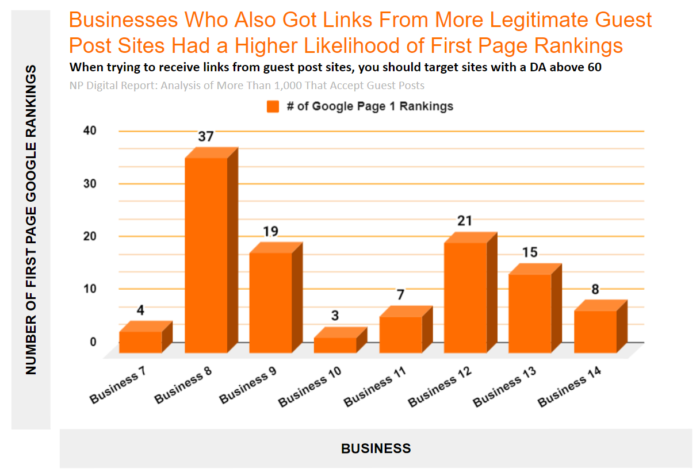
The remaining 8 businesses we looked at also had links from spammy guest posting sites but also received links from more legitimate guest posting sites as well. As in, guest posting sites that had more inbound links than outbound links.
The businesses that built links from the spammy guest posting sites had, on average, 3.16 page 1 rankings on Google. On the other hand, businesses that also built links from the higher quality guest posting sites as well had, on average, 14.25 page 1 rankings on Google.
Keep in mind some industries are easier to rank for than others and some keywords drive less traffic than others, so not all page 1 rankings are created equal.
At the same time, this trend shows that if you target links from higher-quality guest post sites, there is a better chance of ranking on the first page.
When you get links from spammy sites, as in sites whose sole purpose is to link out and don’t get as many links coming in, search engines know this. If this is a practice you have been doing, don’t expect your rankings to go up as much.
On the flip side, if you generate links from higher-quality guest post sites, you are going to be much better off.
The goal of this post was to figure out if links from guest posts really help and now we know the answer. However, if you’re going to build links from guest posts then they should be nofollowed and you should be doing it primarily for branding and referral traffic purposes.
from Neil Patel's Digital Marketing Blog https://ift.tt/mn1zEGr
via IFTTT